




Meet Your Cosmic Shield
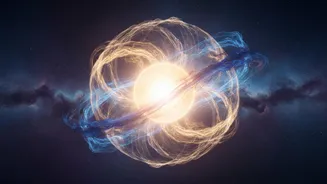
Imagine the Sun constantly sending out a stream of charged particles in all directions. This isn't science fiction; it's the solar wind, and it travels millions of miles per hour, pushing out past all the planets. This solar wind creates a massive magnetic
bubble around our solar system called the heliosphere. Think of it as our solar system's first line of defense. This bubble shields us from a significant amount of harsh galactic cosmic radiation, which originates from deep space. Without this protective layer, life on Earth would be very different, if it existed at all. The heliosphere is our home's interface with the rest of the Milky Way galaxy, and until now, we've only had fleeting glimpses of how it works.
IMAP: The Frontier Mapper
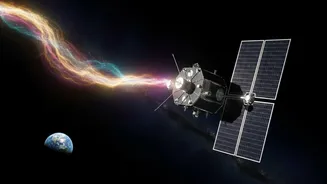
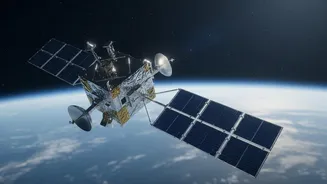
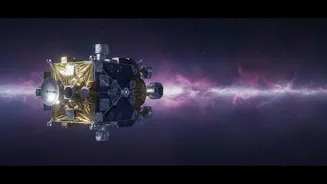
Launched in September 2025, NASA’s Interstellar Mapping and Acceleration Probe (IMAP) is a state-of-the-art celestial cartographer. Its mission is to study this boundary where our Sun's influence ends and interstellar space begins. Positioned about a million miles from Earth towards the Sun, IMAP has a unique, unobstructed view. It's equipped with ten sophisticated instruments designed to 'catch' and analyze particles that have traveled billions of miles from the edge of the heliosphere, as well as particles streaming from our Sun and those that wander in from the galaxy beyond. By examining these cosmic messengers, scientists can piece together the first comprehensive 3D map of our solar system's frontier.
What the First Data Reveals
In early August 2026, NASA made the first batch of science data from seven of IMAP's ten instruments public. This initial release, covering observations made through April 2026, provides a treasure trove for scientists. The data comes from instruments that measure the solar wind's ions and electrons, the interplanetary magnetic field, high-energy particles, and even interstellar dust. While it's still early, these readings are providing the building blocks for understanding the structure and composition of the solar wind before it reaches the heliosphere's edge. One instrument has already captured detailed measurements of an intense solar flare, proving its resilience and value, while another is close to finishing the first-ever all-sky map of neutral atoms arriving from the heliosphere’s outer boundary.
A Galactic Weather Forecast
Understanding the heliosphere isn't just an academic exercise; it has very practical applications. IMAP also functions as an advanced space weather monitoring station. By sampling the solar wind in real-time, it can provide crucial warnings of incoming solar storms and harmful radiation. This is like an early-warning system for space weather, giving operators of satellites, power grids, and especially future crewed missions to the Moon and Mars, valuable time to prepare. The data helps distinguish between extreme natural space events and other phenomena, which is crucial for national security assets in orbit. As humanity ventures further into space, knowing the conditions of our local cosmic environment becomes essential for safety and success.
The Beginning of a New Map
This first data release is just the beginning of IMAP's two-year primary mission. The probe will continue to scan the sky every six months, building up successive maps that will show how our heliosphere 'breathes' and changes in response to the Sun's 11-year activity cycle. By comparing these maps over time, scientists will gain unprecedented insight into the dynamic tug-of-war between the solar wind and the interstellar medium. The Voyager spacecraft, launched in 1977, pierced this boundary, giving us point-source data, but IMAP will show us the whole picture. It will help answer fundamental questions about how our solar system formed, how it moves through the galaxy, and what makes a planetary system habitable.