









The Two Flight Modes Problem
Any aircraft that can take off and land without a runway faces a core engineering conflict. The physics of hovering are completely different from the physics of flying forward at high speed. Vertical lift requires moving a large amount of air straight
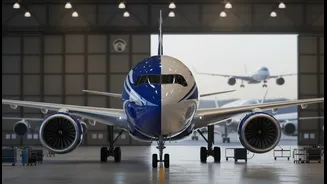
down, which is what a helicopter’s large, slow-spinning rotor does. Efficient forward flight, or cruise, is best achieved with a wing to generate aerodynamic lift and propellers or jets to provide forward thrust, like a conventional airplane. Doing both well with the same systems is incredibly difficult. A helicopter is great at hovering but inefficient and slow in forward flight. An airplane is fast and efficient in the air but needs a long runway. The eVTOL industry's central challenge is to elegantly solve this problem in a single, safe, and quiet electric aircraft.
A Pragmatic Solution: Lift-Plus-Cruise
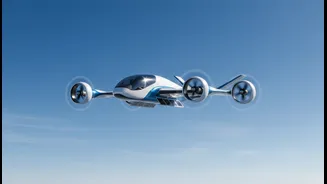
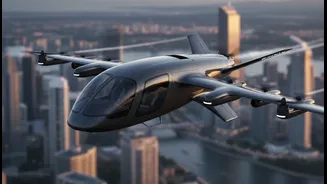
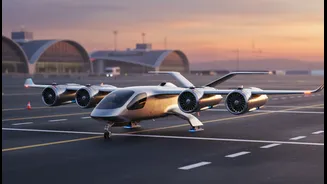
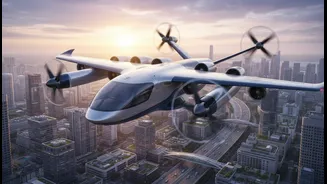
One of the most popular solutions is a design philosophy known as 'lift-plus-cruise'. Instead of trying to make one set of propellers do two very different jobs, this approach uses separate, specialized systems for each phase of flight. The aircraft has a dedicated set of rotors, usually fixed in a horizontal position, that are used only for vertical take-off, landing, and hovering. Once the aircraft is airborne and ready to fly forward, these lift rotors can be powered down. A separate set of propellers, often positioned at the rear (a 'pusher' configuration) or front of the aircraft, provides thrust for forward flight. With its fixed wing, the aircraft then flies like a traditional plane, using aerodynamics to generate lift, which is far more energy-efficient for covering distances.
The Advantage of Simplicity
The main benefit of the lift-plus-cruise design is its mechanical simplicity compared to alternatives like tilt-rotors, where entire motor pods pivot from vertical to horizontal. Having fixed propellers means fewer complex, heavy, and potentially high-maintenance moving parts. This simplicity is a huge asset when it comes to getting an aircraft certified by aviation authorities, who prize reliability and predictable failure modes. By separating the propulsion systems, engineers can optimize each one for its specific job. The lift rotors can be designed purely for efficient and quiet hovering, while the cruise propellers can be optimized for high-speed forward flight. This separation can also build in redundancy; with multiple independent lift motors, the failure of one may not be catastrophic, a key safety advantage over a single-rotor helicopter.
The Trade-Offs: Drag and Dead Weight
However, the design is not without its drawbacks. The most significant is that the propellers used for vertical lift become useless once the aircraft is in cruise mode. They are essentially 'dead weight' being carried along for the ride, and their structure creates aerodynamic drag, which reduces overall efficiency and range. This is the core trade-off: you gain mechanical simplicity but pay a penalty in aerodynamic performance. Competing designs, like tilt-rotors, use the same propellers for both lift and cruise, avoiding this dead-weight problem but introducing significant mechanical complexity in the tilting mechanism. Some studies suggest that while lift-plus-cruise is a strong contender, it may be less energy-efficient on longer missions compared to tilt-rotors due to this added drag.
A Leading Choice for Air Taxis
Despite the compromises, the lift-plus-cruise architecture is one of the most common designs being pursued for passenger and cargo eVTOLs. Companies like Airbus with its CityAirbus NextGen, have adopted this configuration, betting that its balance of performance, safety, and manageable complexity offers the most practical path to commercialization. They argue that for the intended short-hop urban air mobility routes—like a trip from a city center to an airport—the slight hit to cruise efficiency is an acceptable price for a more robust and more easily certifiable aircraft. The design's effectiveness in this specific mission profile is why it remains a frontrunner in the race to fill our future skies.