

Our Solar System's 'Evil Twin'
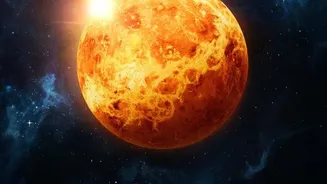
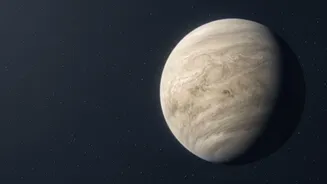
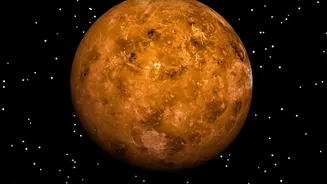
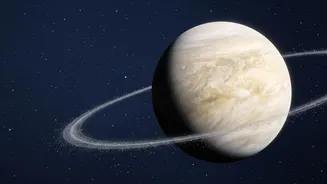
Venus is a perplexing planet. It's similar to Earth in size, mass, and composition, leading scientists to label it our twin. But the similarities end there. Venus is a hellscape, with surface temperatures hot enough to melt lead, a crushing atmosphere
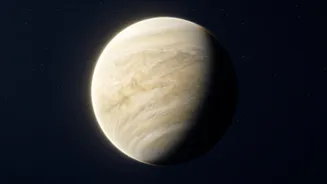
90 times thicker than our own, and clouds of sulfuric acid. Perhaps one of its most bizarre features is its rotation. A single day on Venus lasts 243 Earth days, which is longer than its year. It also spins backward compared to most other planets in our solar system. For decades, scientists have wondered why this otherwise Earth-like world is so different, and in particular, why it is moonless. Previous theories suggested Venus either never had a moon to begin with or lost it in a violent collision with another object. A new study, however, provides a much simpler, and perhaps more tragic, explanation.
A Ghost in Venus's Past
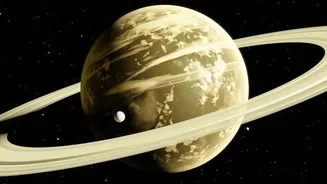
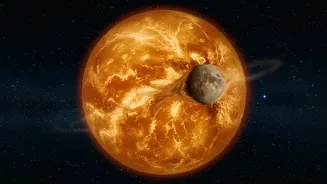
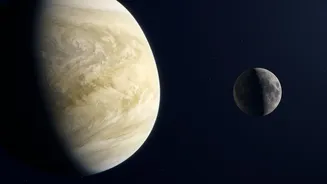
New research led by astrophysicist Stephen Kane at the University of California, Riverside, explores the compelling possibility that Venus did, in fact, have a moon. Early in the solar system's formation, large collisions were common, and the impact that created Earth's Moon could have had a counterpart at Venus. The question then becomes, if Venus had a moon, where did it go? Kane's work suggests we don't need to invoke a second, catastrophic impact to explain its disappearance. Instead, the answer may lie in a constant, powerful force that governs all planets and moons: gravity. Using sophisticated computer models, the researchers simulated what would happen to a hypothetical moon orbiting Venus over billions of years. The results were startlingly consistent. In most scenarios, the moon didn't survive.
The Deadly Physics of a Slow Spin
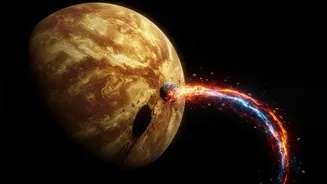
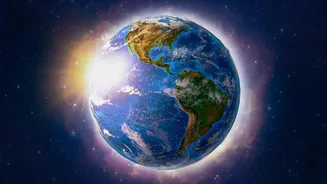
The fate of a moon is locked in a cosmic dance with its planet's rotation, governed by something called tidal forces. Here on Earth, our planet spins relatively quickly—once every 24 hours. This fast rotation transfers rotational energy to the Moon, causing it to slowly spiral away from us at a rate of a few centimetres per year. This interaction also gently slows Earth's rotation over aeons. On Venus, the situation would have been reversed. Because Venus spins so incredibly slowly, the tidal interaction works differently. Instead of pushing a moon away, the planet's gravity would have pulled it inward. This inward spiral would be a slow but relentless march toward destruction, with the moon eventually reaching a point known as the Roche limit. At this distance, the planet's gravitational pull becomes so overwhelming that it tears the smaller body apart, with its debris raining down onto the surface.
The Tipping Point of No Return
The simulations identified a crucial threshold—the “important number” in this celestial story. The fate of a Venusian moon would have depended on how fast the planet was spinning right after its formation. The research found a critical initial rotation period of about 16 hours. If a young Venus was spinning faster than that, a moon could have migrated outward and potentially survived for billions of years, much like our own. But if its initial day was longer than 16 hours, any moon that formed would have immediately begun its inward death spiral. According to the models, a moon caught in this gravitational trap would have been completely destroyed in as little as one million years. Larger moons would have met this fate even faster, as their stronger gravitational pull would have accelerated the process.
What This Means for Planet Hunting
While the simulations do not definitively prove Venus ever had a moon, they offer a powerful and elegant explanation for its absence today. They show that the planet’s own physics could have been responsible for its solitary status, a natural consequence of its slow rotation rather than a chance encounter with a wandering asteroid. This research has profound implications beyond our solar system. As we discover more exoplanets orbiting distant stars, understanding the relationship between a planet's rotation and its ability to retain moons is critical. This study suggests that slowly rotating rocky planets are unlikely to have large moons. Since moons can play a key role in stabilising a planet's axis and creating tides—factors that could be important for habitability—this finding helps astronomers refine their search for worlds that might harbour life.