



Our Galaxy's Sleeping Giant
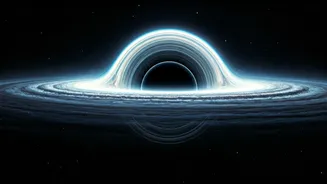
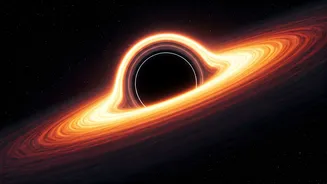
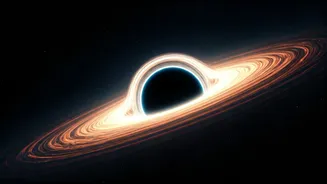
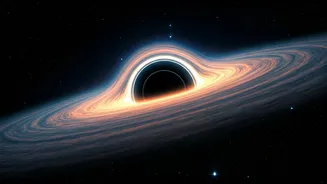
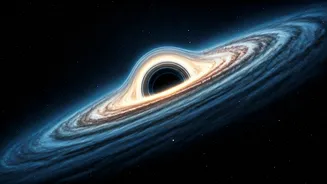
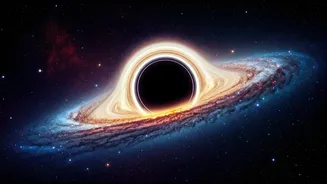
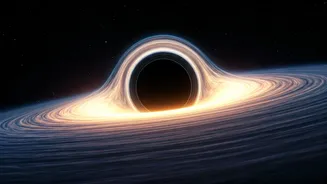
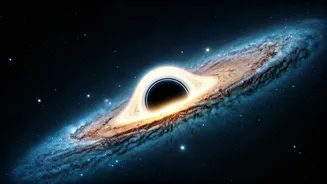
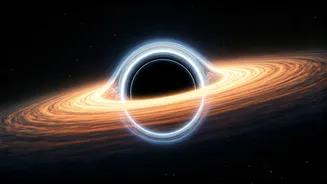
Sagittarius A, or Sgr A for short, is the anchor of our galaxy, a point of immense gravity around which everything else revolves. Located about 27,000 light-years from Earth, it is our closest supermassive black hole. Yet, for all its power, Sgr A has
always been considered surprisingly quiet. While black holes in other galaxies often put on spectacular shows, violently spewing out jets of matter and energy, ours is comparatively placid. It consumes very little material, equivalent to a human eating a single grain of rice over a million years. This quietness has made it both a fascinating and frustrating object of study, a sleeping giant whose true nature has been shrouded in cosmic dust and mystery.
The 50-Year Search for a Ghostly Wind
Astrophysical theories have long predicted that all black holes, no matter how quiet, should produce an outflow of particles—a sort of 'black hole wind'. As matter falls toward a black hole, not all of it gets consumed. The intense energy and pressure in the chaotic region near the event horizon should blast some of this material back out into space. Evidence of ancient, massive eruptions from Sgr A exists in the form of enormous structures called the Fermi Bubbles that extend far above and below our galaxy's plane. However, finding a present-day, active wind has been an elusive, 50-year quest. The galactic center is one of the most obscured regions of the sky from our viewpoint, hidden behind dense clouds of gas and dust that make direct observation incredibly difficult.
A Signature of Absence
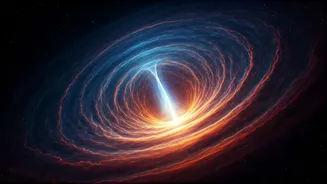
The breakthrough came not from seeing something new, but from noticing something that was missing. Using the Atacama Large Millimeter/submillimeter Array (ALMA) in Chile, a team of astronomers created the most detailed map ever of the cold gas surrounding Sgr A. After using advanced techniques to subtract the overwhelming radio glare from the black hole itself, they were left with a picture 100 times more sensitive than any before it. In that map, they found the 'strange signature': a distinct, cone-shaped cavity in the distribution of cold gas, about three light-years across. This void wasn't random; it was pointing directly away from the black hole, like the invisible wake of a boat.
The Wind Finally Revealed
This cavity was the smoking gun. It could only have been carved out by a persistent force pushing the cold gas aside. Scientists concluded this force was the long-sought black hole wind. While the cold gas (traced by carbon monoxide molecules) was being pushed away, data from NASA's Chandra X-ray Observatory showed that the same cavity was filled with very hot gas. The astronomers reasoned that the hot wind, blowing from the black hole, is either shoving the cold gas out of its path or heating it up so much that it's no longer detectable as 'cold'. The team ruled out winds from nearby stars, which would not be powerful enough to create such a large structure. They estimate this wind has been blowing steadily for at least 20,000 years, constantly reshaping the heart of our galaxy.
Why This Cosmic Discovery Matters
Confirming the existence of this wind solves a major puzzle and fundamentally deepens our understanding of the environment around supermassive black holes. It proves that Sgr A*, despite its quiet nature, is not an exception to the rules of physics; it interacts with its surroundings just as theories predicted. This discovery provides a unique cosmic laboratory for studying the 'normal' state of a black hole. Most black holes we observe in distant galaxies are in a hyperactive, 'fireworks' stage, which is actually rare over their entire lifespan. By studying the gentle but persistent wind of our own sleeping giant, scientists can better understand the typical, quiet life of the billions of other supermassive black holes scattered across the universe and their subtle, long-term influence on the evolution of their host galaxies.