





The Quest for Affordable Spaceflight
For decades, space launches have operated on a simple, but incredibly expensive, model: build a rocket, launch it, and let its most expensive parts burn up or fall into the ocean. The Indian Space Research Organisation (ISRO) is on a mission to change
that paradigm with its Reusable Launch Vehicle (RLV) program. The centerpiece of this ambitious project is a winged vehicle named Pushpak. Designed to function like a hybrid of a rocket and an aircraft, its ultimate goal is to drastically reduce the cost of putting satellites into orbit. By recovering and reusing the launch vehicle, ISRO aims to slash launch costs by as much as 80 percent. This would not only make India a fiercely competitive player in the global commercial launch market but also make our own national space ambitions—from satellite constellations to deep space exploration—more sustainable and affordable. The journey is a long one, composed of a series of complex technology demonstration missions, each one building on the last.
Mastering the Art of the Landing
Before a vehicle can be reused, it must first prove it can return to Earth safely and precisely. This was the focus of a series of critical tests known as the Landing Experiments (LEX). In these missions, the Pushpak vehicle was carried to an altitude of 4.5 kilometres by an Indian Air Force Chinook helicopter and released to perform an autonomous landing on a runway. The first test, RLV-LEX-01, proved the concept was viable. The second, RLV-LEX-02, was even more challenging; Pushpak was deliberately released off-course and had to autonomously correct its flight path to nail the landing, which it did perfectly. To prove the principle of reusability, the very same vehicle from the second mission was used again for the third and final landing test, RLV-LEX-03, which also ended in a flawless success. This trio of successful landings demonstrated that ISRO has mastered the crucial terminal phase of flight, proving its autonomous navigation, guidance, and control systems are ready for the next step.
The Next Great Leap: An Orbital Trial by Fire
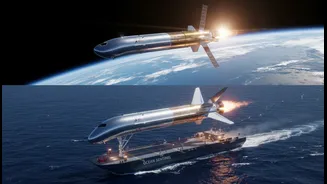
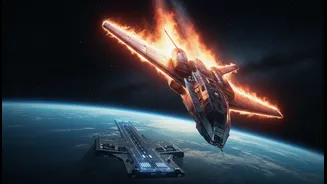
The successful landing tests, while significant, were essentially practice runs in the lower atmosphere. The next phase of the program, the Orbital Re-entry Experiment (ORE), is where the real challenge begins. This mission will see a vehicle, an enlarged version of the Pushpak prototype, launched into a 400-kilometre-high orbit around the Earth. After orbiting the planet, it will have to fire its engines to begin its descent, plunging back into the atmosphere at hypersonic speeds. This is an entirely different and exponentially more difficult problem than being dropped from a helicopter. The vehicle will have to endure the punishing physics of re-entry from orbital velocity, a feat that tests the absolute limits of material science and aerospace engineering. This upcoming mission is the true test of India's reusable rocket ambitions, and it carries with it a new level of risk and complexity.
Why Re-Entry Is the Hardest Part
Successfully returning from orbit is one of the most daunting challenges in spaceflight. As the vehicle slams into the upper atmosphere at more than 25 times the speed of sound, the friction with air molecules will generate unimaginable heat, turning the surrounding air into plasma. The vehicle's Thermal Protection System, a shield made of special heat-resistant tiles, must withstand temperatures that can melt steel, all while the craft's autonomous systems fight to maintain stability. Unlike the gentle glide from 4.5 km, the re-entry from 400 km is a violent, high-energy event where margins for error are razor-thin. Any failure in the heat shield, control surfaces, or guidance systems could lead to the vehicle burning up or losing control. This is why the headline's caution holds true for this next phase; despite past successes, a successful recovery from orbit is never guaranteed on the first attempt.
The Prize for India's Space Program
The stakes for the upcoming Orbital Re-entry Experiment could not be higher. A successful mission would place India in an elite club of nations with proven reusable spaceplane technology. The ability to launch, recover, and reuse orbital vehicles would be a game-changer for ISRO, providing the country with strategic autonomy in space access. It would unlock the potential for a higher frequency of launches at a fraction of current costs, directly benefiting programs like Gaganyaan, future lunar missions, and the deployment of critical infrastructure in space. As global players like SpaceX continue to advance their own reusable technologies, ISRO's Pushpak program is India’s definitive answer. It represents a critical investment in a future where space is not just a frontier for exploration, but a sustainable and accessible domain for science, commerce, and national security.