





An End to a 50-Year Mystery
For half a century, astronomers have operated under a core assumption: when black holes feed on surrounding gas and dust, they should also expel some of that material in powerful outflows called winds. While these winds have been seen in other, more active
galaxies, our own supermassive black hole, Sagittarius A (Sgr A), remained a puzzle. It appeared to be a surprisingly tidy eater, showing no clear evidence of this expected outflow. Now, a team of researchers from Northwestern University has announced a breakthrough. Using new, highly detailed observations, they have found the first definitive evidence of a wind blowing from Sgr A, solving a long-standing astronomical mystery.
What Exactly Is a Black Hole Wind?
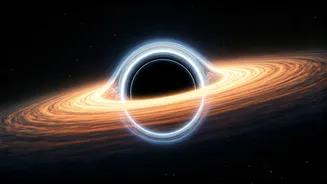
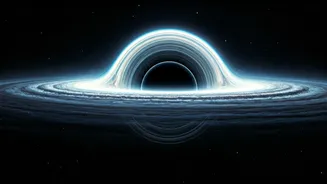
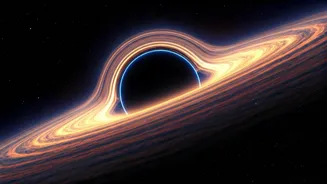
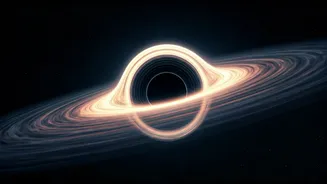
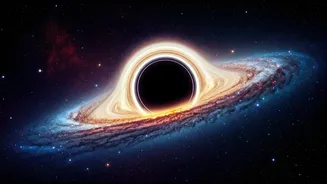
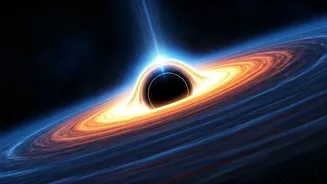
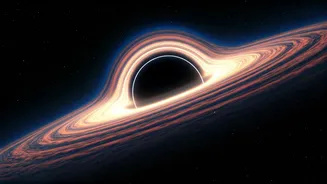
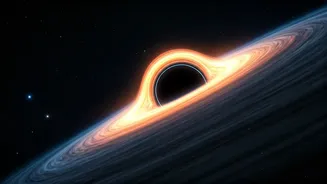
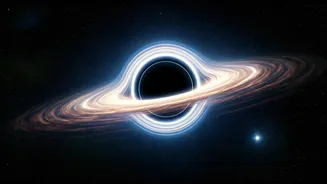
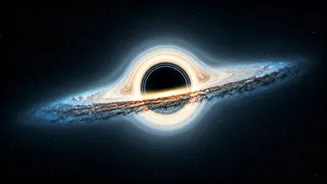
Contrary to their name, black holes don't just swallow everything. As gas and dust are pulled toward a black hole, they form a swirling, superheated disk. The intense energy and radiation from this disk can become so powerful that it pushes some of the infalling material away at incredible speeds. This outflow of gas is what scientists call a black hole wind. These winds can be gentle breezes or violent gales capable of clearing out huge areas of space. In very active galaxies, these winds play a crucial role in shaping the galaxy itself, influencing how and where new stars are born.
How Scientists Found the Invisible
Detecting the wind from our relatively quiet black hole was a monumental task. The center of the Milky Way is obscured by thick clouds of gas and dust, making direct observation difficult. The research team combined five years of observations from the Atacama Large Millimeter/submillimeter Array (ALMA) in Chile to create the sharpest map ever of the cold gas near Sgr A*. After processing the data to remove the black hole's own bright glow, they discovered a huge, cone-shaped cavity in the surrounding cold gas. This void was the smoking gun—an imprint carved out by a hot wind pushing the cold gas aside. The finding was reinforced by earlier data from NASA's Chandra X-ray Observatory, which showed the cavity was filled with the kind of hot, X-ray-emitting gas you would expect to find in a black hole wind.
A Gentle Breeze from a Quiet Giant
The wind from Sgr A isn't the raging tempest seen in more dramatic galaxies, which are often called quasars. Instead, it's more of a gentle breeze, which is why it was so hard to detect. Sgr A is considered to be in a quiet state, feeding on an incredibly small amount of material—equivalent to a single grain of rice over a million years for a human. This discovery confirms that even dormant black holes like ours are still actively interacting with their environment. Based on the size of the cavity, scientists estimate this wind has been blowing for at least 20,000 years.
Why This Changes Our Galactic View
This discovery fundamentally changes our understanding of the heart of our own galaxy. It shows that Sgr A is not a unique exception to the rules of black hole physics but a normal, albeit quiet, example. The presence of this wind, however gentle, has significant implications for our galactic neighborhood. These outflows can regulate star formation, either by compressing gas to trigger the birth of new stars or by blowing it away and preventing it. By finally seeing the wind from Sgr A, astronomers have a unique window into the typical, quiet state that most supermassive black holes exist in for the majority of their lives, allowing them to better model how galaxies and their central black holes evolve together.