



The Foundation: A Tale of One Ingredient
At the heart of both Sandesh and Rasgulla is a single, magical ingredient: chhena. This fresh, unripened cheese is made by curdling full-fat cow's milk and straining the solids. Chhena is the foundational element for a vast majority of Bengali sweets,
prized for its soft, moist texture that readily absorbs flavour. However, the path this humble ingredient takes after its creation is what sets these two iconic sweets worlds apart. While they share a common ancestor, their textures, flavours, and very identities are shaped by two distinct journeys of preparation. Rasgulla celebrates chhena in its purest, spongiest form, while Sandesh transforms it into a dense, decadent confection.
Syrup vs. Solids: The Great Divide
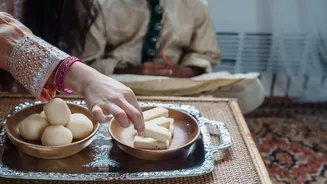
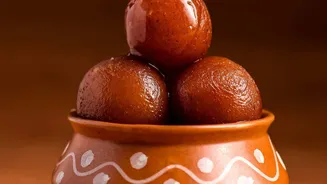
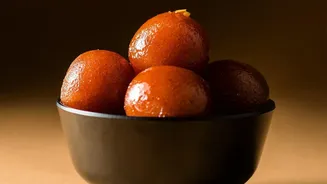
The most fundamental difference lies in their interaction with sugar and heat. For Rasgulla, freshly made chhena is kneaded until smooth and rolled into small balls. These balls are then dropped into a boiling, thin sugar syrup. As they cook, they puff up, absorbing the sweet syrup to become light, spongy, and juicy spheres. The goal is to preserve a delicate, melt-in-your-mouth texture. Sandesh, on the other hand, is what food writers might call a 'dry' sweet. Here, the chhena is kneaded with sugar or jaggery and then cooked over a low flame. The confectioner gently stirs the mixture, reducing its moisture content until it forms a dense, fudgy mass. This process concentrates the milky flavour and creates a solid, mouldable sweet, a world away from Rasgulla's syrupy embrace.
A Canvas for Culinary Art
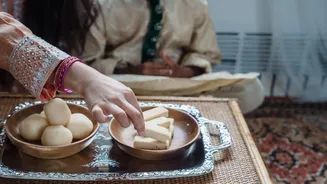
While Rasgulla is a masterpiece of minimalism, Sandesh is a canvas for creativity. Rasgulla is cherished for its simple perfection—the pure taste of milk, sugar, and perhaps a hint of cardamom or rosewater. Its form is almost always a perfect sphere. Sandesh, however, is a playground of flavours and shapes. Once the base is prepared, it can be moulded into intricate forms like fish, conch shells, or flowers. The flavour variations are virtually limitless. You might find Sandesh infused with saffron, pistachio, mango, or even chocolate. The most prized variety is the Nolen Gurer Sandesh, made exclusively in winter with fresh date palm jaggery (nolen gur), which imparts a smoky, caramel-like flavour and a beautiful brown hue that is treasured across Bengal.
Texture, Taste, and Temperature
The end results are polar opposites in sensory experience. A perfect Rasgulla is served chilled, dripping with light syrup, and should spring back when gently squeezed. Its joy is in the burst of sweet liquid and the airy, spongy texture. Sandesh is typically served at room temperature and is entirely solid. Its texture can range from soft and crumbly (naram paak) to firm and dense (kora paak). The simplest form, called kanchagolla, is barely cooked, offering a moist, grainy feel. Eating Sandesh is about savouring a rich, concentrated milk fudge that slowly melts on the tongue, releasing its nuanced flavours.
An Emblem of 'Bengaliness'
Both sweets are integral to Bengali culture, but they often play slightly different roles. Rasgulla is a symbol of hospitality, often the first sweet offered to guests. Its fame has made it a pan-Indian phenomenon. Sandesh, whose name literally translates to 'message' or 'news', was traditionally shared to mark good tidings. It is considered by many to be a more refined, artisanal sweet—an 'emblem of Bengaliness' that reflects a deep culinary heritage. While modern sweet shops have made both readily available, the sheer variety and artistry involved in Sandesh give it a special place in the hearts of connoisseurs.