



A Panoramic Window on the Cosmos
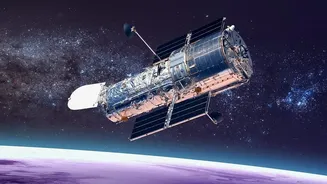
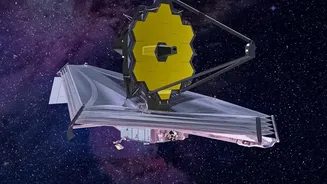
Imagine trying to understand a sprawling forest by looking at it through a keyhole. That’s been the challenge for astronomers. Telescopes like Hubble and the James Webb Space Telescope (JWST) provide incredibly deep and detailed views of small patches
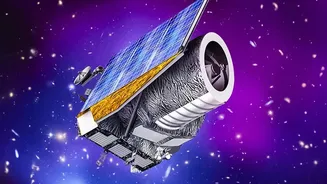
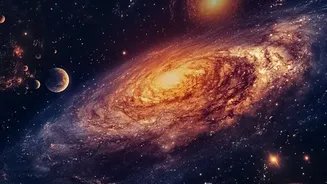
of sky. The Nancy Grace Roman Space Telescope, which launched in August 2026, takes a different approach. Its primary power lies in its enormous field of view. Armed with a 2.4-meter mirror—the same size as Hubble's—its Wide Field Instrument can capture an area of the sky at least 100 times larger in a single snapshot. This 'wide-angle' lens allows Roman to map the sky with unprecedented speed, gathering more data in its five-year primary mission than Hubble has in over 30 years. Instead of focusing on individual cosmic 'trees', Roman will survey the entire 'forest', observing billions of galaxies to create vast, high-resolution panoramas of the universe.
Shedding Light on Dark Energy
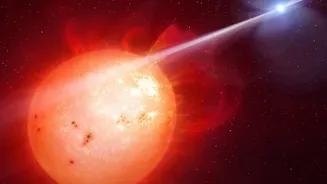
One of the biggest puzzles in cosmology is dark energy, the mysterious force causing the universe's expansion to accelerate. It’s believed to make up roughly 68% of the cosmos, but its nature is completely unknown. Roman will tackle this enigma by observing the universe's structure across cosmic time. It will use three key methods. First, it will hunt for Type Ia supernovae, which are exploding stars that act as 'standard candles' because their intrinsic brightness is known, allowing scientists to measure cosmic distances precisely. Second, it will map the distribution of galaxies to find the subtle imprint of Baryon Acoustic Oscillations (BAO)—ancient sound waves from the early universe that provide a 'standard ruler' to measure expansion. Finally, it will use weak gravitational lensing, studying how the light from distant galaxies is distorted by the gravity of intervening matter, to map the growth of cosmic structures. Together, these techniques will create a 3D map of the universe, revealing how dark energy has shaped it over billions of years.
Mapping the Invisible Scaffolding
The galaxies we see are not scattered randomly; they are embedded in a vast, invisible web of dark matter. This mysterious substance provides the gravitational scaffolding for all visible structures. Roman's wide-field surveys are perfectly suited to map this unseen architecture. By measuring the subtle distortions in the shapes of millions of distant galaxies—a phenomenon known as weak gravitational lensing—scientists can infer the location and density of the dark matter that caused the distortion. This will create the most detailed maps ever of the distribution of dark matter, helping astronomers test theories about its properties and its role in galaxy formation and the evolution of the universe's large-scale structure. Essentially, Roman will make the invisible visible on a grand scale.
A Census of New Worlds
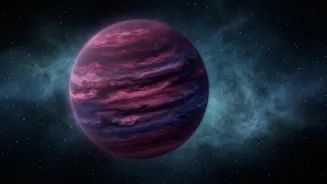
Beyond cosmology, Roman will revolutionize the search for planets outside our solar system, or exoplanets. It will conduct a massive survey using a technique called gravitational microlensing. This occurs when a star or planet passes in front of a more distant star, and its gravity acts like a magnifying glass, temporarily brightening the background star's light. This method is sensitive enough to find planets with masses as small as Mars and even 'rogue' planets that roam the galaxy untethered to a star. Because it doesn't rely on light from the planet itself, microlensing can find worlds much farther away and of different types than other methods. Roman is expected to discover thousands of new exoplanets, providing a statistical census that will help us understand how common different types of planetary systems are throughout our galaxy.