







The Gift That Keeps on Giving
More than a decade after its historic flyby in 2015, NASA’s New Horizons mission is still rewriting our understanding of Pluto. The spacecraft, which provided the first-ever close-up images of the dwarf planet, collected a treasure trove of data that
scientists continue to pore over. A recent study published in the Planetary Science Journal provides some of the most tantalizing evidence yet that Pluto is not the frozen, dormant world we once imagined. Instead, it shows signs of recent liquid activity, a shocking possibility on a world where surface temperatures plummet to around minus 230 degrees Celsius. According to Alan Stern, the principal investigator for New Horizons, "Pluto never stops surprising us."
A Tale Told in Nitrogen
The new evidence centers on Sputnik Planitia, the vast, heart-shaped basin of frozen nitrogen larger than Texas and Oklahoma combined. Analysis of high-resolution images revealed dark, linear, and diffuse features along the northern edge of this massive glacier. Scientists believe these markings strongly resemble features on Earth's own glaciers that have been wetted by liquid. However, Pluto’s thin atmosphere makes liquid nitrogen rain impossible. This has led researchers to a stunning conclusion: the liquid nitrogen is likely flowing up from beneath the glacier through cracks, temporarily wetting the surface before freezing again. This suggests a kind of geological activity and a time-variable feature previously unseen on Pluto.
The Wobble and the Ocean
This discovery of surface liquid adds another layer to an already compelling theory: that Pluto harbors a vast, hidden ocean of liquid water beneath its icy shell. For years, scientists have grappled with the strange orientation of Sputnik Planitia, which sits almost directly opposite Pluto's large moon, Charon. This alignment is unlikely to be a coincidence. One leading theory suggests the basin was created by a massive impact that carved away a huge amount of ice. This thinning of the crust may have allowed a subsurface ocean to push upward, creating a dense, heavy bulge of water and ice. Over millions of years, the gravitational pull from Charon would have caused the entire planet to roll over—a process called true polar wander—to put this extra mass in its current, stable location. The existence of a liquid ocean is one of the best explanations for how this reorientation could have happened.
How Does a Distant World Stay Warm?
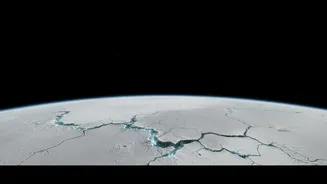
The question, then, is how a small world so far from the sun could retain enough heat to keep water in a liquid state for billions of years. One theory is that Pluto had a “warm start,” forming rapidly and trapping heat from its creation under a thick insulating ice shell. Another key factor could be radioactive decay within Pluto’s rocky core, which would generate a steady, slow release of heat. Some models even suggest the ocean might be extremely salty, which would act like a natural antifreeze, lowering the water's freezing point. Evidence for this ancient ocean may be etched onto Pluto’s face in the form of massive cracks and faults, created as the crust stretched over a still-liquid interior.