







The City of Joy's Grand Awakening
Weeks before the main festivities, an electric buzz fills the air in Kolkata. The city sheds its routine to embrace its biggest celebration. This is Durga Puja, an event so integral to the city's identity that it was inscribed on UNESCO's list of Intangible
Cultural Heritage of Humanity in 2021. For ten days, but especially the final five, Kolkata becomes a grand, open-air art exhibition. Streets are illuminated, the sound of traditional 'dhaak' drums echoes through lanes, and millions of people engage in 'pandal-hopping'—a city-wide pilgrimage to admire the temporary temples built to house the goddess. It's a time when social divisions blur, and the city unites in a shared spirit of creativity and celebration.
Heritage and History: The Bonedi Bari Pujas
Away from the bustling public squares are the 'Bonedi Baris'—the ancestral homes of Kolkata's erstwhile aristocratic families. Here, Durga Puja unfolds not as a public spectacle, but as an intimate, time-honoured tradition passed down through generations. These pujas, some centuries old, take place in the grand courtyards ('thakurdalans') of these palatial homes. The rituals are elaborate and specific to each family, from the food offered to the goddess to unique ceremonies like the 'Dhuno Porano'. The idols, known as 'Sabeki Pratima', are traditional, often adorned with heirloom gold jewellery, and sculpted in a classic style that contrasts sharply with modern interpretations. Visiting a Bonedi Bari puja is like stepping back in time, offering a glimpse into the festival's deep-rooted history.
Creativity Unleashed: The Modern Theme Pandals
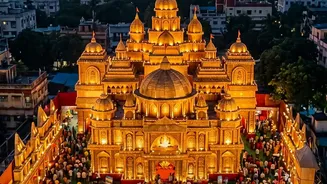
In stark contrast to the Bonedi Baris are the 'theme' pandals, which represent the festival's modern, dynamic, and competitive spirit. Each year, neighbourhood clubs and communities vie to create the most innovative and spectacular pandals, transforming temporary structures into replicas of world landmarks, scenes from mythology, or platforms for social commentary. These pandals are not just places of worship but massive art installations, drawing on the skills of artists, designers, and lighting experts to create immersive experiences. In recent years, themes have also focused on sustainability, with organisers using biodegradable materials and promoting environmental awareness. This contemporary expression of faith demonstrates how the festival continually evolves, blending artistic ambition with devotional fervour.
The Art of Devotion: Crafting the Divine
The heart of the festival's artistry lies in Kumartuli, the potters' quarter in North Kolkata. For months, skilled artisans meticulously craft thousands of idols from clay sourced from the Hooghly River. This craft is a generational legacy, a blend of skill and devotion. The process starts with a bamboo and straw frame, which is then layered with clay. A pivotal moment is 'Chokkhu Daan', the ritual painting of the goddess's eyes, which is believed to infuse the idol with life. This act symbolises the transformation of mere clay into a divine entity, ready for worship. The entire process is a profound artistic and spiritual journey that forms the backbone of the celebration.
A Feast for the Senses
Durga Puja is as much a culinary celebration as it is a religious one. The streets of Kolkata become a massive food festival, with stalls offering everything from the iconic 'phuchka' and 'kathi rolls' to Kolkata-style biryani. A central part of the culinary experience is the 'bhog'—a traditional meal offered to the goddess and then distributed to devotees. This typically consists of 'khichuri', a mixed vegetable dish called 'labra', and fried items. Beyond the pandals, restaurants curate special Puja menus, and households prepare elaborate feasts. It is a time for indulgence, where food becomes a medium for community, sharing, and celebration.