







A New Chapter in Earth Observation
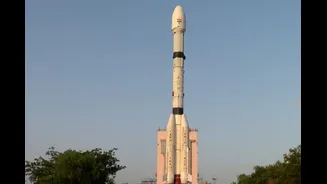
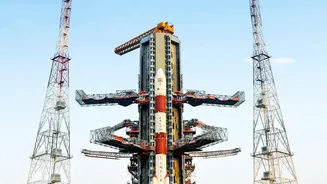
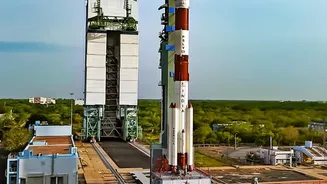
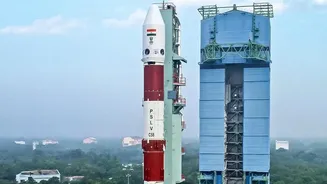
On September 4, 2026, the Indian Space Research Organisation (ISRO) successfully launched the EOS-05 satellite aboard its GSLV-F17 rocket from the Satish Dhawan Space Centre in Sriharikota. This was a landmark moment, as EOS-05 is India's first dedicated
imaging satellite to be placed in a geosynchronous orbit, approximately 36,000 kilometres above the Earth. Unlike satellites in low-Earth orbit that pass over a location intermittently, a satellite in geosynchronous orbit can continuously monitor the same broad geographical region. This gives India the capability for near-continuous observation of the subcontinent, a game-changer for various applications.
Redemption for a Lost Mission
The success of EOS-05 carries deep significance as it effectively completes the mission of its predecessor, GISAT-1 (also known as EOS-03). In August 2021, the launch of GISAT-1 failed when the GSLV-F10 rocket's cryogenic upper stage malfunctioned, preventing the satellite from reaching its orbit. The failure was a notable setback for ISRO's ambition to establish persistent surveillance capabilities. The EOS-05 mission, launching nearly five years later, is essentially the second attempt to achieve this goal, making its success a moment of technical and psychological redemption for the space agency. It also marked a successful return to launch operations for ISRO after a seven-month hiatus following a separate PSLV mission failure in January 2026.
What EOS-05 Brings to the Table
Dubbed India's 'eye in the sky', EOS-05 provides a powerful new tool for both civilian and strategic purposes. Its ability to maintain a constant watch over the Indian landmass and surrounding oceans is invaluable for disaster management, enabling the rapid monitoring of cyclones, floods, and forest fires. The satellite is also equipped with multi-spectral and hyperspectral cameras, allowing it to gather detailed information for agriculture, forestry, and monitoring changes in water bodies and vegetation. Furthermore, this persistent monitoring capability significantly enhances India's strategic and border surveillance, providing a constant stream of data for security applications.
A Boost for the 'Naughty Boy'
The successful launch was also a major vote of confidence for the Geosynchronous Satellite Launch Vehicle (GSLV), a rocket that has historically had a mixed performance record, earning it the informal nickname 'Naughty Boy'. The failure of the GSLV-F10 in 2021 was linked to its complex cryogenic upper stage, a technology that ISRO spent decades mastering. The flawless performance of the GSLV-F17 in placing the heavy 2,367 kg EOS-05 satellite into a precise orbit demonstrates the growing reliability of the launch vehicle. This success is crucial as the GSLV is tasked with launching some of India's most important and heavy payloads, including future communication and navigation satellites.
The Bigger Picture for India's Space Programme
The EOS-05 mission fits into India's larger strategy of building an integrated space ecosystem. By proving its capabilities in complex missions, ISRO can continue to focus on frontier science and exploration while encouraging greater participation from the private sector in manufacturing and downstream data applications. The data from EOS-05, for example, can be translated into actionable intelligence by private geospatial companies, creating a vibrant industry around space-based services. This success reinforces India's position as a major space-faring nation capable of developing and deploying sophisticated technology for national development and security. It provides valuable momentum for ISRO as it looks ahead to future missions, including those related to the Gaganyaan human spaceflight programme.