




A Star's Dramatic Final Act
Imagine a star many times more massive than our sun. For millions of years, it has burned through its fuel, creating heavier and heavier elements in its core. But eventually, the fuel runs out. Without the outward push from nuclear fusion, gravity takes
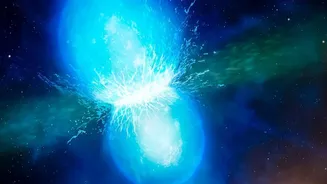
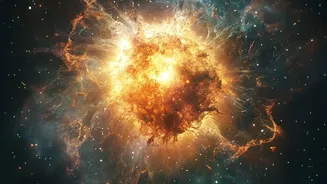
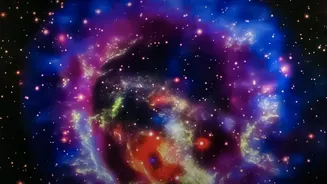
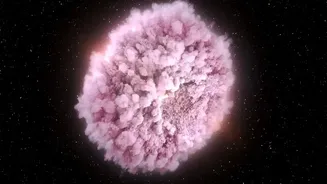
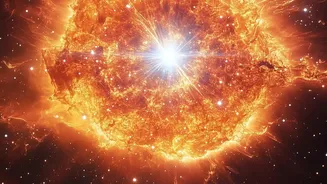
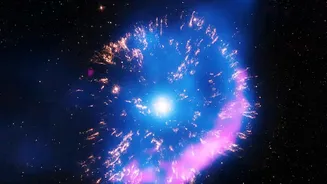
over with relentless force. In a fraction of a second, the star's core implodes, crushing matter to densities beyond comprehension. This catastrophic event, known as a core-collapse supernova, is one of the most violent phenomena in the universe. It triggers an explosion that can outshine an entire galaxy, forging and scattering heavy elements across the cosmos. The remnant left behind is either an incredibly dense neutron star or, if the star is massive enough, a black hole. For decades, scientists have tried to model this process, but a crucial question has remained: what tips the scales between these two fates?
The Ghost Particle's Decisive Role
Enter the neutrino. Often called 'ghost particles,' neutrinos are fundamental particles with almost no mass and no electric charge, allowing them to pass through most matter as if it were not there. Trillions pass through your body every second, completely unnoticed. Yet, in the heart of a dying star, they are anything but insignificant. A core collapse produces a staggering flood of neutrinos—so many that they carry away about 99% of the explosion's immense energy. A tiny fraction of these neutrinos get absorbed by the material surrounding the core, providing the critical push needed to revive the stalled shockwave and blow the star apart. Without this neutrino heating, there would be no supernova explosion; the star would simply collapse. This makes neutrinos the primary engine of one of the universe's grandest events.
A Breakthrough in 'Flavor-Changing'
The latest research, published in the journal Physical Review D, adds a fascinating new layer to this story. Scientists have long known that neutrinos come in three types, or 'flavors,' and that they can switch between these flavors as they travel—a process called oscillation or flavor conversion. However, most supernova simulations assumed this effect was negligible. The new study challenges this idea. Researchers from the University of Copenhagen ran complex simulations and found that these flavor changes can have a dramatic impact. Because the different neutrino flavors interact with matter differently, switching flavors can alter how much energy is deposited in the star's outer layers. The study found that including these flavor conversions in their models made it significantly harder for some stars to explode.
Predicting Black Holes vs. Neutron Stars
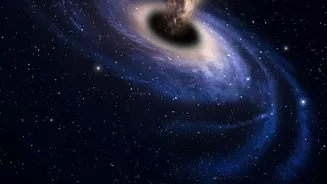
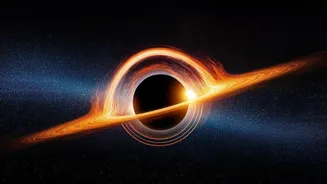
This discovery directly impacts our ability to predict whether a star will form a neutron star or a black hole. According to the new simulations, stars in a specific mass range—between 16 and 30 times the mass of our sun—are particularly sensitive to neutrino physics. In standard models, many of these stars would explode as supernovae. But when neutrino flavor conversion is included, a large number of them fail to explode and instead collapse directly into black holes. This could help solve a long-standing mystery in astrophysics known as the 'supernova rate problem,' where astronomers observe far fewer supernovae than theoretical models predict. Many of these 'missing' supernovae might be massive stars that are collapsing quietly into black holes, an outcome made more likely by the subtle physics of neutrinos.
Refining Our Picture of the Cosmos
The implications of this research are profound. By incorporating a more accurate model of neutrino behavior, astrophysicists can create more reliable simulations of stellar death. This not only helps explain the observed rates of supernovae and black holes but also refines our understanding of how heavy elements are created and distributed throughout the universe. Furthermore, it could improve predictions for gravitational waves, which are generated during these violent cosmic events. The study underscores that the largest events in the cosmos are intricately linked to the physics of the smallest particles. As lead author Mariam Gogilashvili stated, a small change in how neutrinos behave can decide the fate of an entire star.