


A Theory of Planetary Cannibalism
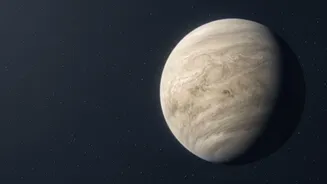
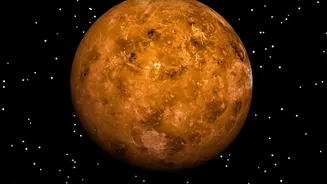
For years, scientists have debated why Venus orbits the sun alone, unlike its neighbour Earth. Some theories proposed a catastrophic impact destroyed a Venusian moon long ago, while others suggested one never formed in the first place. However, new simulations
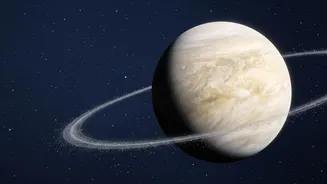
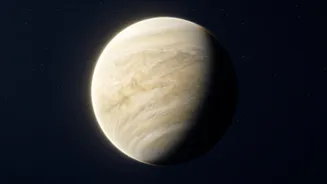
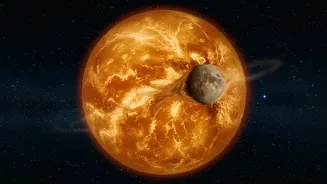
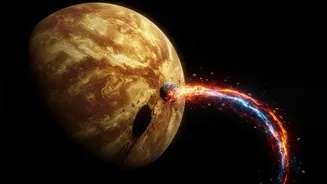
from astrophysicist Stephen Kane at the University of California, Riverside, suggest a more intimate demise: Venus may have devoured its own moon. According to research published in The Astrophysical Journal, the planet's own gravity, combined with its unique rotation, could have been enough to pull a hypothetical moon into a death spiral. This model suggests no external disaster was needed; Venus’s own physics may have doomed its satellite from the start.
The Science of a Slow Death
The fate of a moon is tied to its planet's rotation. Earth spins relatively quickly, completing a rotation in 24 hours. This transfers rotational energy to our Moon, causing it to slowly drift away from us at a rate of about four centimetres per year. Venus is the complete opposite. It has an incredibly slow rotation, taking 243 Earth days to complete a single turn, and it spins backwards compared to most other planets. The new computer models show that this sluggish spin would have the reverse effect on a moon. Instead of pushing it away, the tidal forces between Venus and its satellite would sap the moon's orbital energy, causing it to spiral inward until it ultimately crashed into the planet or was torn apart by its gravity. Kane’s simulations showed that for most scenarios, including moons of various sizes, the final result was a collision with the planet.
An Enduring Solar System Mystery
This new theory provides a compelling answer to a long-standing question, but it’s important to note what it doesn't do. The study doesn't prove that Venus definitely had a moon. Instead, it demonstrates that if a moon did form around Venus, its survival would have been highly unlikely under the planet's specific conditions. The simulations showed that the more massive a moon was, the faster it would have been pulled in and destroyed. This hypothesis offers a more straightforward explanation than previous ideas involving giant, secondary impacts. It suggests the absence of a moon might be a natural consequence of Venus’s evolution. Finding direct physical evidence of such a collision is difficult, as about 80% of Venus's surface was geologically 'resurfaced' about a billion years ago, likely erasing any ancient craters or impact scars.
What This Means for Earth's Twin
Understanding this process could help solve other mysteries about Venus. A massive moon crashing into the planet would have delivered an enormous amount of energy, potentially altering its geology, atmosphere, and climate forever. Such an event could have contributed to the planet's runaway greenhouse effect and the loss of any water it may have once had. This theory also has implications beyond our solar system. As astronomers search for Earth-like exoplanets that could potentially host life, the presence of a moon is often considered a factor for habitability. This research shows that even if a planet is capable of forming a moon, it might not be able to keep it, especially if the planet rotates slowly. It adds another layer of complexity to understanding how habitable worlds form and evolve over billions of years.