


A Discovery Frozen in Time
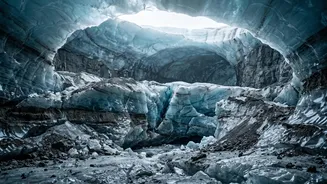
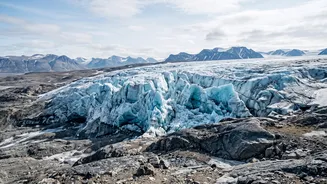
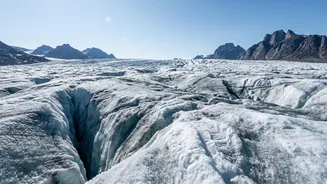
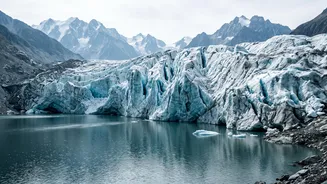
On Canada's Baffin Island, the last surviving piece of the ancient Laurentide Ice Sheet, known as the Barnes Ice Cap, holds a remarkable secret. Recent studies led by researchers from Columbia University have found that after thousands of years of shrinking,
this ice cap began to grow again around two millennia ago. This expansion was part of a long, slow, and natural cooling phase in the Northern Hemisphere, driven by subtle, periodic shifts in Earth's orbit that reduced the amount of summer sunlight hitting the Arctic. For nearly 2,000 years, the ice cap steadily advanced, a sign that the planet might have been inching toward a new glacial period, often called an ice age. That is, until the 20th century.
How Plants Tell the Story
The key to this discovery lay in what the ice left behind—and what it preserved. The Barnes Ice Cap is 'cold-based', meaning it's frozen solid to the ground it rests on. Unlike typical 'warm-based' glaciers that slide and grind away the landscape, a cold-based ice cap acts more like a protective blanket. As it expanded over the centuries, it gently smothered and entombed the tundra plants, like mosses, in its path. By using radiocarbon dating on these perfectly preserved, ancient plants as they are now being exposed by the ice cap's recent retreat, scientists can create a precise timeline of the ice's advance. The dates of these 'killed' plants show a clear pattern: the ice margin began to creep forward roughly 2,000 years ago, initiating a long period of growth.
Natural Cooling Meets Modern Warming
The expansion of the Barnes Ice Cap was part of a long-term cooling trend known as the Neoglacial period, which culminated in the 'Little Ice Age' from roughly 1300 to 1850. During this time, glaciers advanced in many parts of the world due to natural factors, including slight changes in Earth's orbit and increased volcanic activity. However, the research shows that this long, natural cooling trend came to an abrupt end. Around 1960, the growth of the Barnes Ice Cap suddenly stopped and reversed. For the first time in two millennia, the amount of ice melting in the summer began to overpower the amount of snow accumulating in the winter. The culprit was the rapid increase in atmospheric greenhouse gases from human activity, which caused temperatures to rise at a rate far exceeding the subtle influence of Earth's orbital cycles.
What This Means for Climate Change
This research does not contradict the reality of modern climate change. In fact, it sharpens our understanding of it. By establishing a clear timeline of natural climate cycles, scientists can see just how unusual and powerful the current warming trend is. The slow, multi-millennial cooling trend was decisively overridden in just a few decades by human-induced warming. The study suggests that without industrial emissions, our planet would likely still be in a long-term cooling phase, potentially on the path to a new ice age thousands of years from now. Instead, the opposite is happening. The Barnes Ice Cap, once a growing remnant of a mighty ice sheet, is now projected to melt completely within the next few centuries, a stark symbol of how profoundly humans have altered Earth's climate system.