





The Universe's Biggest Mystery
For decades, physicists and astronomers have been grappling with a profound puzzle: the universe is much heavier than it appears. All the stars, planets, and galaxies we can see only make up about 5% of the total mass of the cosmos. The vast majority,
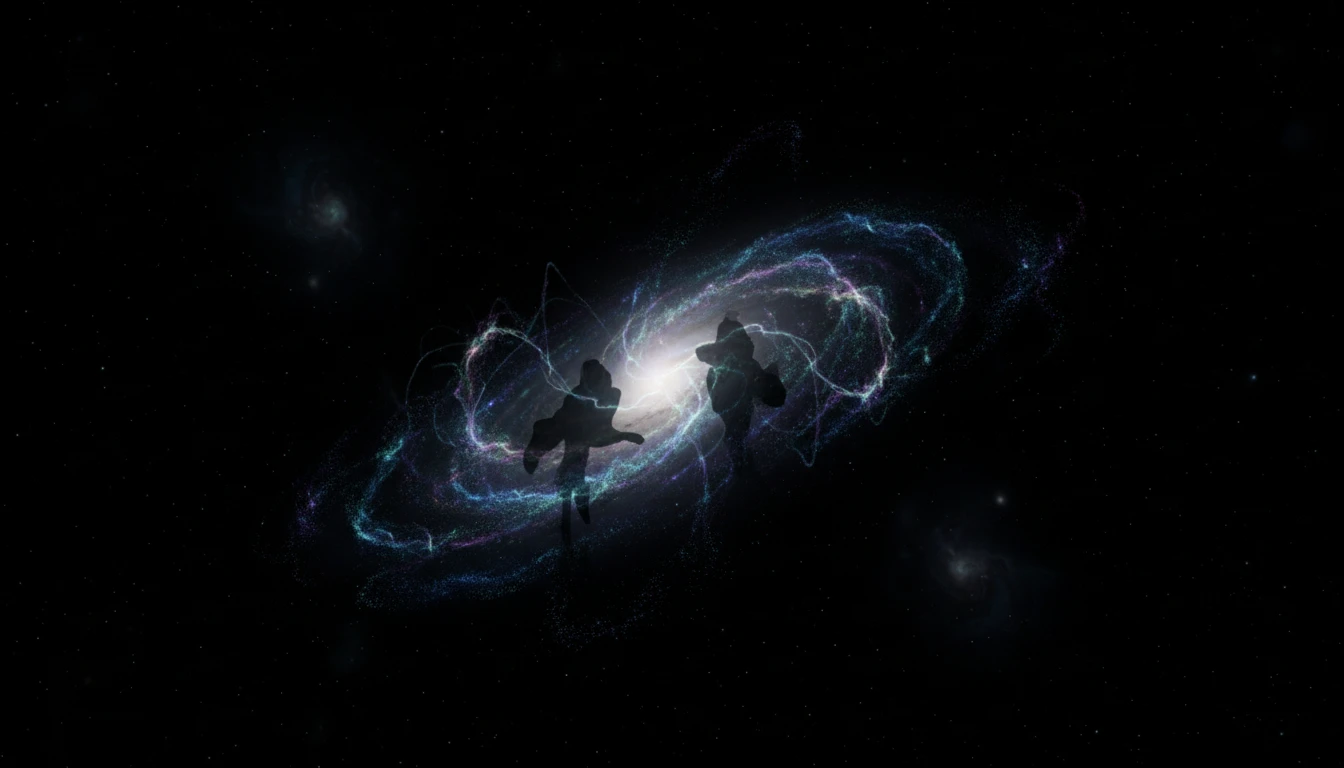
about 27%, is an invisible, untouchable substance known as dark matter. We can't see it or measure it directly because it doesn't interact with light or any other form of electromagnetic radiation. Its existence is inferred only through its immense gravitational pull, which acts like a cosmic glue holding galaxies together and shaping the large-scale structure of the universe. Without it, galaxies would fly apart. This makes finding dark matter one of the most critical quests in modern physics.
New Theories and Fresh Doubts
The headline-making news is not about one single experiment failing, but rather part of a larger, evolving story in physics. Recently, a team of physicists from the University of Sheffield proposed a compelling new theory. Their idea, published in Physical Review D, suggests that dark matter might exist in a hidden fifth dimension, resonating like a musical instrument. This 'dark matter resonance' could explain why it was more interactive in the early universe but is so elusive today, an idea that provides new targets for researchers. However, the field is constantly being tested. Separate research has recently cast doubt on one of the long-standing pieces of evidence for dark matter, the Bullet Cluster, suggesting alternative explanations might account for the gravitational effects seen there. This push and pull of new ideas and rigorous testing is what drives science forward.
Ruling Out Possibilities
In the hunt for dark matter, scientists have explored numerous candidates, from WIMPs (Weakly Interacting Massive Particles) to MACHOs (Massive Compact Halo Objects). More recent ideas include 'fuzzy' dark matter, which suggests it's more like a quantum wave than a particle. Each theory must be tested. Sometimes, as with the work from Sheffield scientists and their collaborators, a result doesn't confirm a theory but instead rules out certain possibilities. For example, in a separate but related effort, recent experiments like COSINE-100 and ANAIS-112 decisively challenged a nearly 30-year-old claim of a seasonal dark matter signal, effectively removing a long-standing but uncorroborated result from the puzzle. This process of elimination is not a failure; it is a fundamental part of the scientific method.
Why a 'No' is a Win for Science
Think of the search for dark matter like trying to find a specific key on an enormous, invisible keyring. Every time an experiment fails to find a certain type of particle in a certain energy range, it’s like learning that one of the keys on the ring is not the right one. This allows the global scientific community to cross that possibility off the list and focus their time, money, and brainpower elsewhere. Ruling out a potential candidate or a detection method refines the map of the unknown. It prevents future researchers from going down blind alleys and helps steer the entire field toward more promising directions. Each null result sharpens the search and brings physicists one step closer to understanding the true nature of the universe's hidden scaffolding.
The Narrowed Path Forward
So, what happens now? The road to understanding dark matter has become more focused. With some older claims being set aside and new theoretical frameworks like Sheffield's fifth-dimension resonance being proposed, the field is anything but stagnant. Theories involving multiple types of dark matter particles or interactions with other elusive particles like neutrinos are gaining traction. As one study co-author noted, confirming a new interaction would be a fundamental breakthrough, giving particle physicists a concrete direction for laboratory experiments. The journey is far from over, but by knowing where not to look, the chances of eventually looking in the right place become much higher. The path has been narrowed, and for scientists, that is a sign of progress.