





Our Solar System's Protective Bubble
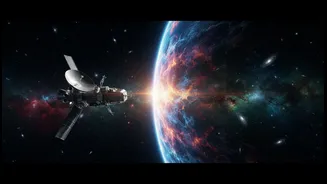
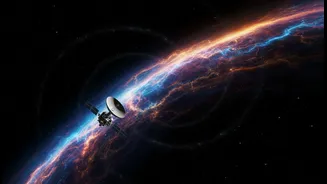
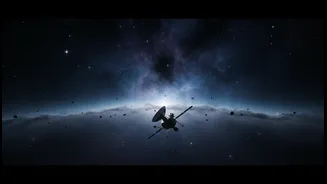
Our solar system isn't just floating in an empty void. It's enclosed within a giant, protective bubble called the heliosphere. This bubble is created by the solar wind, a constant stream of charged particles flowing outwards from the Sun. It pushes back
against the interstellar medium—the gas, dust, and plasma that fill the space between stars—creating a boundary that shields planets like Earth from a significant amount of harsh galactic cosmic radiation. This shield is crucial; without it, life on our planet might have evolved very differently, if at all. The edge of this bubble, known as the heliopause, is where the pressure from our Sun's solar wind finally balances out with the pressure of the interstellar medium. It's the true frontier of our solar system.
A Veteran Explorer on the Frontier
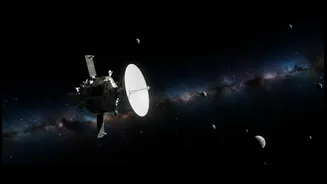
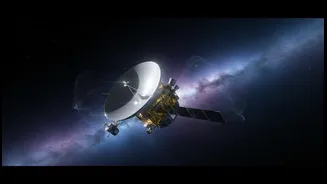
Enter New Horizons. Launched in 2006, this intrepid probe has already made history multiple times. It gave humanity its first-ever close-up look at Pluto in 2015 and followed that up with a flyby of Arrokoth in 2019, the most distant object ever explored by a spacecraft. Having recently awakened from a nearly year-long hibernation in July 2026, New Horizons is currently healthy and active, travelling through the Kuiper Belt at a distance of about 9.5 billion kilometres from Earth. While the Voyager 1 and 2 probes have already crossed into interstellar space, they did so with older technology. New Horizons carries a more modern and sensitive suite of scientific instruments, making it uniquely equipped to study this mysterious region in greater detail.
A New Mission on the Horizon
The spacecraft's current extended mission has it studying the outer heliosphere and the Kuiper Belt. As it journeys farther from the Sun, its instruments are measuring the solar wind, dust, and energetic particles. The primary goal of this potential next phase is to study the 'termination shock'—the point where the solar wind dramatically slows down as it approaches the interstellar medium. Scientists are eager for the data New Horizons could collect during this encounter, which would be a treasure trove for understanding how this vast boundary works. While there is no new Kuiper Belt flyby target currently identified, NASA has extended the mission to allow it to continue gathering this vital heliophysics data as it heads toward the solar system's edge, expected sometime between 2028 and 2029.
Unlocking Cosmic Mysteries
A better look at the heliosphere's edge isn't just about mapping our backyard. It's about fundamental physics. New Horizons' plasma and particle detectors, like SWAP and PEPSSI, can measure how the solar wind evolves and interacts with interstellar particles in ways the Voyager probes couldn't. Its ultraviolet spectrograph, Alice, will observe how hydrogen from interstellar space flows through the heliosphere. These observations will provide critical data to refine our models of how our solar system interacts with the rest of the galaxy. This knowledge helps us understand the environments around other stars and what makes a planetary system potentially habitable. By studying our own protective bubble, we learn more about the conditions necessary for life elsewhere in the universe.
The Road Ahead
The mission isn't without its challenges. The spacecraft is now so far away that it takes a radio signal nearly nine hours to travel from Earth to the probe. Furthermore, the power from its radioisotope thermoelectric generator is slowly declining, requiring careful management of resources and increased autonomy. Scientists estimate that New Horizons could cross the termination shock anytime between 2029 and 2040, a wide window because the heliosphere itself 'breathes'—expanding and contracting with the Sun's 11-year activity cycle. For now, the spacecraft will continue its journey, acting as our most distant observatory and waiting for its chance to pierce the veil between our solar system and the vast interstellar ocean beyond.