




A Historic Liftoff
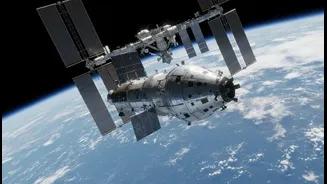
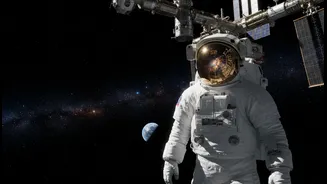
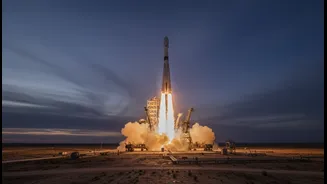
On July 14, 2026, all eyes were on the Baikonur Cosmodrome in Kazakhstan as the Roscosmos Soyuz MS-29 spacecraft thundered into the sky. Onboard was Anil Menon, embarking on his inaugural spaceflight alongside Russian cosmonauts Pyotr Dubrov and Anna
Kikina. The launch marks the start of an approximately eight-month stay aboard the orbiting laboratory, where Menon will serve as a flight engineer for Expeditions 74 and 75. The journey represents a monumental personal achievement and a moment of immense pride for the global Indian community, watching as one of their own ventures into the cosmos.
From Kerala Roots to Global Aspirations
Born in Minneapolis, Minnesota, to an Indian father and a Ukrainian mother, Menon’s story is one of multicultural heritage. His family roots trace back to Ottapalam in Kerala’s Palakkad district, and he is the great-grandson of Sir Chettur Shankaran Nair, a prominent lawyer and freedom fighter during the British Raj. This deep connection to India was nurtured early; Menon spent a year in the country as a Rotary Ambassadorial Scholar, where he supported local polio vaccination campaigns. His journey is a testament to the far-reaching influence of the Indian diaspora.
A Career in Service and Extremes
Long before he aimed for the stars, Anil Menon built a distinguished career grounded in service on Earth. An actively practicing emergency medicine physician, he has been a first responder in some of the world's most challenging situations, including the 2010 earthquake in Haiti and the 2015 earthquake in Nepal. As a lieutenant colonel in the U.S. Air Force, he served on the front lines in Afghanistan and volunteered with the Himalayan Rescue Association to treat climbers on Mount Everest. His extensive experience in wilderness and aerospace medicine shaped his ability to perform under extreme pressure, a critical skill for any astronaut.
Pioneering at SpaceX
Menon played a pivotal role in the modern commercial space race as SpaceX's first-ever flight surgeon. He joined the company in 2018, where he was instrumental in developing its medical program to support human spaceflight. He helped launch the first humans to space on the historic Demo-2 mission and supported the first all-civilian mission, Inspiration4. His work was crucial in ensuring crew safety and building the medical framework for future missions, including the ambitious Starship program, bridging the gap between government-led exploration and the new era of commercial space travel.
The NASA Dream Realized
In December 2021, from a pool of over 12,000 applicants, Menon was selected to join NASA's astronaut candidate class. He had previously served NASA as a crew flight surgeon starting in 2014, supporting astronaut expeditions to the ISS from the ground. His selection marked the culmination of a lifelong ambition, leading to two years of intensive training. He graduated alongside his fellow astronaut candidates in March 2024, fully prepared for the challenges of spaceflight and ready to take his place among the elite few who get to journey beyond Earth's atmosphere.
Science in the Stars
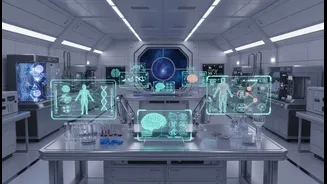
During his eight-month mission, Menon will not just be a passenger but a key scientific contributor. He will conduct a wide range of experiments, including research into the in-space production of semiconductor crystals, which could revolutionize high-performance computing. As both a researcher and a test subject, he will help scientists understand the effects of microgravity on human physiology, studying blood flow and testing new medical technologies like an ultrasound that uses augmented reality. This work is vital for protecting astronaut health on long-duration missions to the Moon and Mars.