




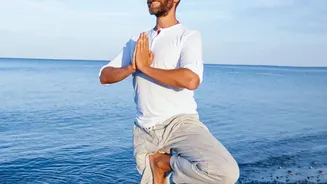

The Foundation of Your Practice
The single most important quality of your beach practice spot is that it must be flat. Tai Chi is built on the principle of 'rooting'—a stable, grounded connection to the earth that allows for balance and the smooth flow of energy. A poorly aligned body
can disrupt your centre of gravity. While the soft, uneven sand of a typical beach can challenge and improve your balance over time, beginners should seek out the firm, damp sand left by a receding tide. This provides a stable surface that allows your feet to connect fully with the ground, which is essential for proper alignment, sinking your weight, and maintaining the structural integrity of your postures. Without a stable base, it's easy to become unbalanced and lose the meditative focus of the practice.
Creating Clarity for Mind and Body
A 'clear' space refers to two things: physical clearance and mental clearance. Physically, you need enough room to perform your movements without inhibition—a space where you can extend your arms fully without hitting driftwood, a sandcastle, or another beachgoer. An area clear of sharp shells, rocks, or debris is also crucial for safety, allowing you to move with confidence. Mentally, a clear space helps reduce distractions. While observing your natural surroundings can be part of a mindful practice, you want a spot that offers a degree of privacy and seclusion. This allows your focus to remain internal, on your breath and movement, rather than on external activity. A space that feels open yet contained is ideal for achieving the inner stillness that Tai Chi promotes.
Harnessing the Energy of the Waves
Being 'away from incoming waves' is a critical safety instruction. A sudden sneaker wave can not only soak you and your belongings but can also knock you off balance, posing a serious risk of injury. Check the tide charts before you go and set up well above the high-tide line. Beyond safety, your position relative to the water affects the sensory experience. The rhythmic sound of the ocean can be a wonderful, natural metronome for your breathing and movements. However, if you are too close, the crashing can be overpowering and distracting rather than soothing. By positioning yourself at a comfortable distance, you can use the ambient sound of the waves as a backdrop for focus, rather than an interruption to it.
Finding the Perfect Moment
Beyond the physical characteristics of the spot, timing can greatly enhance your beach practice. Early morning, just before or during sunrise, is often considered the best time. The air is fresh, the light is soft, the temperature is cooler, and the beach is often less crowded, providing the peace and space you need. This quiet time allows you to connect more deeply with your surroundings and absorb the emerging energy of the day. Practicing during these tranquil hours transforms your session from a simple exercise into a holistic experience that integrates your mind, body, and the natural world around you.