






A Seafloor in the Sky
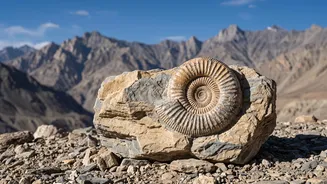
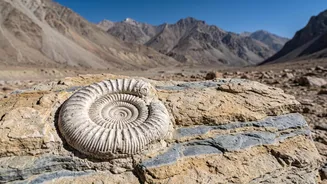
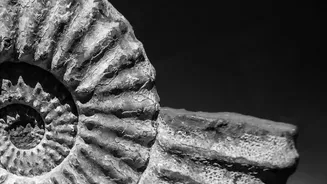
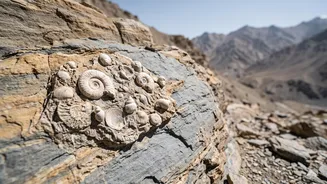
In the remote Changthang region of eastern Ladakh, geologist Dr. Ritesh Arya recently unearthed a significant collection of marine fossils. Discovered in Nyoma, the assemblage includes spiral-shaped gastropods (snail-like molluscs), bivalves, and oyster-like
forms. These creatures are not from a modern ocean; a preliminary analysis suggests they are approximately 34 to 38 million years old, dating back to the Eocene epoch. Finding remnants of marine life in a region thousands of metres above sea level provides a fascinating window into a time when the geography of the Indian subcontinent was dramatically different. The fossils are physical proof that what is now the roof of the world was once an ocean floor.
The Subathu Connection
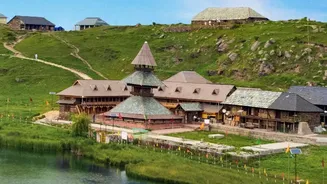
The key to understanding the significance of these fossils lies in their striking similarity to those found in the well-known Subathu Formation, a belt of rocks in the Himalayan foothills, particularly around Himachal Pradesh. The Subathu Formation is named after a town near Shimla and consists of fossil-rich sedimentary rocks that were deposited in a shallow, warm sea during the Palaeocene-Eocene epochs. For geologists, Subathu is a critical reference point for the ancient marine environment that existed just before the final, cataclysmic collision between the Indian and Eurasian tectonic plates. The discovery in Nyoma suggests this ancient seaway, often called the Subathu marine realm, extended much farther east into Ladakh than previously thought.
Closing the Tethys Ocean
The story begins over 50 million years ago. The landmass we know as India, once part of the supercontinent Gondwana, was drifting northwards across a vast ocean called the Tethys. As it moved, the Tethys Ocean began to shrink. The Subathu sea was a final, narrow arm of this once-great ocean, a shallow marine passage that separated the advancing Indian plate from the Eurasian plate. The fossils found in both Subathu and now Ladakh are the remains of the creatures that lived in this seaway. Their existence traces the final moments of a marine world before one of the most significant geological events in Earth's history.
From Ocean Bottom to Mountain Top
The presence of these fossils at such extreme altitudes is a direct consequence of the Himalayan mountain-building process, known as orogeny. Around 50 million years ago, the Indian plate collided with the Eurasian plate. Because both were continental plates, neither would slide easily under the other. Instead, the immense pressure buckled, folded, and thrust the Earth's crust upwards. The sedimentary rocks that had formed on the floor of the Tethys and Subathu seas, containing the trapped fossils of marine life, were squeezed and lifted thousands of metres into the air, eventually becoming the peaks of the Himalayas.
Rewriting Geological History
This discovery is more than just a curiosity; it reshapes the scientific understanding of Himalayan paleogeography. The fossils suggest that in the Eocene epoch, Ladakh was not a cold desert but a coastal environment with a warm, shallow sea fringed by palms and subtropical vegetation. For researchers at institutions like the Wadia Institute of Himalayan Geology, these findings provide crucial data points for mapping the precise timeline and geographic extent of the Tethys Ocean's closure. Each fossil helps to refine models of tectonic collision and climate change, offering a clearer picture of how the subcontinent's iconic northern frontier was formed.