






Deconstructing the Core Challenge
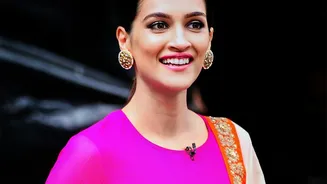
At first glance, Kriti Sanon's workout, shared by her fitness coach Karan Sawhney, looks like a playful interaction with a stability ball. The actor hangs from an overhead bar and performs rapid flutter kicks against the ball. However, this is an advanced
variation of a hanging leg raise, an exercise already considered a gold standard for core training. The fundamental movement requires an individual to hang from a bar and lift their legs, fighting against gravity. This action primarily targets the rectus abdominis (the "six-pack" muscles) and the hip flexors. Unlike floor exercises like crunches, which have a limited range of motion, hanging allows the spine to decompress and the core to work harder to stabilize the entire body.
The Instability Factor
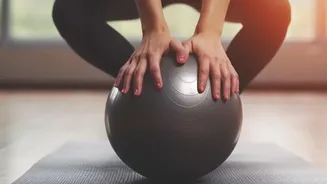
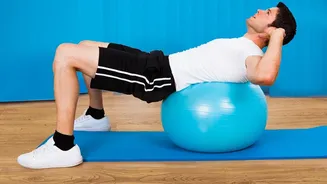
Adding a stability ball, also known as a Swiss ball, takes this challenge to a new level. The ball is an unstable surface by design. In Sanon's workout, she isn’t just lifting her legs; she is directing them toward a moving target. This forces her abdominal muscles to do more than just flex; they must constantly fire to prevent her torso and pelvis from swinging out of control. This need for stabilization engages the deeper core muscles, like the transverse abdominis, which acts as the body's natural corset, and the obliques, which control rotation and side-to-side movement. Every kick against the ball sends a reactive force back through her body, and her core has to absorb and control it instantly.
More Than Just Abs
What makes this a truly advanced exercise is that it’s a compound movement that tests the entire body. While the core is the star of the show, several other muscle groups are working overtime. First is grip strength. Simply hanging from a bar for an extended period is a challenge in itself and is often the first point of failure for many people. Her forearms, hands, and shoulders are under immense isometric tension to support her body weight. Furthermore, the lats (latissimus dorsi) in the back are engaged to keep her shoulders stable and prevent her from turning into a passive pendulum. Finally, the hip flexors and even the quads are heavily involved in the rapid kicking motion, requiring both strength and endurance.
The Benefits of Elite Core Training
Mastering a move like this comes with significant functional benefits that translate beyond the gym. This level of core strength improves posture, enhances balance, and provides powerful support for the spine, which can help prevent lower back pain. For athletic performance, a strong, stable core is the foundation of all powerful movements, from running and jumping to lifting. The coordination and body awareness required to control the limbs while the trunk remains stable is a key athletic skill. This exercise is a testament to functional fitness, training muscles to work together in a coordinated fashion, much like they do in daily life and sports.
Should You Try This? A Reality Check
While inspiring, this is not a beginner's exercise. Attempting it without a strong foundation can lead to using momentum instead of muscle, which negates the benefits and increases the risk of shoulder strain or injury. Building up to it is key. Experts suggest starting with foundational core exercises like planks, floor-based leg raises, and hollow body holds to build baseline strength. From there, one can progress to hanging knee raises, where the legs are bent to shorten the lever and make the movement more manageable. Once you can perform several controlled sets of hanging knee raises and straight-leg raises without swinging, you might be ready to incorporate the stability ball. But the golden rule is always control over momentum.