




A Landmark Trial Begins
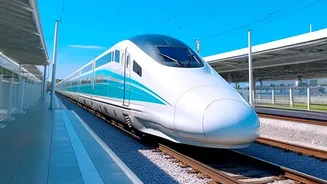
The Mysuru Division of South Western Railway is overseeing these critical field trials, which began on August 12 and are expected to continue for several days. A specially prepared 20-coach Vande Bharat rake, manufactured by the Integral Coach Factory
in Chennai, is being used for the tests. Personnel from the Research Designs and Standards Organisation (RDSO) are on board to meticulously assess the train's performance, focusing on acceleration, braking, stability, and other operational parameters under the unique and demanding conditions of the ghat section. This is not just a routine check; it is a feasibility study to determine if India's premier semi-high-speed train can conquer one of its most challenging railway lines.
The Challenge of the Ghats
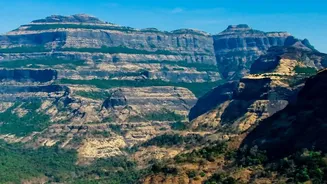
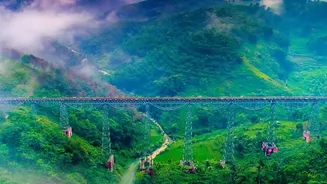
So, what makes the Sakleshpur-Subrahmanya stretch so formidable? This 55-kilometre section, which cuts through the dense Western Ghats, is an engineering marvel and an operational gauntlet. It features an exceptionally steep gradient of 1-in-50, meaning the track rises one metre for every 50 metres travelled. The route snakes through 57 tunnels and crosses 226 bridges, all while navigating 108 sharp curves. Historically, trains have required the assistance of 'banker' locomotives—extra engines attached at the rear—to push them up the steep inclines. The area is also highly susceptible to landslides, especially during monsoons, adding another layer of complexity to both construction and operation.
A Train Built for the Task
The Vande Bharat Express is uniquely equipped to handle such terrain without the need for banker locomotives. Unlike conventional trains pulled by a single engine, the Vande Bharat boasts a distributed power system, with motors in multiple coaches. This provides superior power and adhesion, which is crucial for climbing steep gradients. Furthermore, the train is fitted with a sophisticated microprocessor-controlled electro-pneumatic braking system. For these trials, the rake has been specially equipped with an Automatic Emergency Braking (AEB) system, designed to automatically apply the brakes if the train exceeds the section's speed limit of 30 kmph, providing a critical layer of safety.
Revolutionising Connectivity
The successful completion of these trials would be a game-changer for connectivity between Karnataka's state capital, Bengaluru, and the coastal city of Mangaluru. The introduction of a Vande Bharat service promises a significant reduction in travel time, offering faster and more comfortable journeys. This development is also expected to provide a major boost to tourism in the region, improving access to popular destinations like Kukke Subrahmanya and the scenic hills of Sakleshpur. The journey itself, through the verdant landscape of the Western Ghats, would become a premier travel experience. Full electrification of the entire Bengaluru-Mangaluru route, completed in December 2025, laid the groundwork for this ambitious plan.
The Road Ahead
While the initial trials are a significant milestone, a commercial run is not yet imminent. Once the RDSO team compiles and analyses the data, the results will be reviewed by the Railway Board and the Commissioner of Railway Safety. Only after receiving all necessary safety clearances can a regular passenger service be introduced. Railway officials have confirmed that these tests are a mandatory part of establishing the train's suitability before any final decision is made. However, the very fact that these trials are underway marks a bold step forward in Indian Railways' mission to modernise its network and enhance connectivity across even the most difficult terrains.