







The Fading Heartbeat of a Space Pioneer
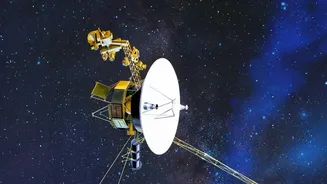
Voyager 2, along with its twin Voyager 1, is powered by a device called a radioisotope thermoelectric generator (RTG). Think of it as a nuclear battery that converts heat from decaying plutonium into electricity. At launch, the RTGs provided about 470
watts, but the plutonium decays over time, causing the power supply to drop by about four watts every year. After decades of exploring Jupiter, Saturn, Uranus, and Neptune and pushing into interstellar space, the power margins on the nearly 50-year-old probe have become incredibly thin. This dwindling power has forced mission managers into a difficult game of conservation, shutting down non-essential systems and even some science instruments to keep the spacecraft alive. Without intervention, another of its few remaining instruments was scheduled to be turned off in 2026.
An Interstellar 'Big Bang'
You can't send a mechanic to a spacecraft that's more than 20 billion kilometres away, with a command taking over 19 hours to reach it. So, engineers at NASA's Jet Propulsion Laboratory had to get creative. They devised a plan, nicknamed the “Big Bang,” which involved a delicate, simultaneous swap of onboard systems. The team sent commands to turn off certain powered devices and substitute them with lower-power alternatives that were already on the spacecraft. A crucial part of this long-distance operation was ensuring the probe remained just warm enough to function in the near-absolute-zero temperatures of interstellar space. This risky maneuver, which Voyager's project manager noted had “no do-overs,” successfully freed up just enough power to keep its remaining science instruments running.
Old Hardware, New Tricks
This isn't the first time engineers have found ingenious ways to prolong the mission. In a previous effort, they tapped into a small reservoir of backup power that was originally set aside for an onboard safety mechanism—a voltage regulator designed to protect instruments from power fluctuations. By deciding to use this reserved power, they took a calculated risk. While the spacecraft's voltage would no longer be as tightly regulated, the electrical systems had proven remarkably stable over the decades, making the safety net less critical. These engineering feats demonstrate a core principle of managing such legacy missions: when you can’t add new hardware, you have to rethink how you use the hardware you have. The recent 'Big Bang' procedure is expected to keep all three of Voyager 2's remaining active science instruments operating for at least another year.
The Priceless Science That Waits
The science data that Voyager 2 is sending back becomes more valuable the farther it travels from the Sun. It and its twin are the only spacecraft to have ever directly sampled the interstellar medium—the space between the stars. The three instruments still operating are the magnetometer, the plasma wave subsystem, and the cosmic ray subsystem. Together, they provide unprecedented data on the density and temperature of interstellar plasma, magnetic fields, and the cosmic rays that pervade our galaxy. Losing even one of these instruments would diminish the quality of the science. This successful power-saving maneuver ensures that for at least one more year, humanity will continue to receive a complete picture from this lonely outpost, pushing the boundaries of our knowledge about the galaxy we inhabit.