







A Shared Story: The Churning of the Ocean
The foundation for most eclipse-related beliefs in Hinduism is a dramatic tale from the Puranas: the Samudra Manthan, or the churning of the cosmic ocean. In this story, the gods and demons worked together to produce Amrit, the nectar of immortality.
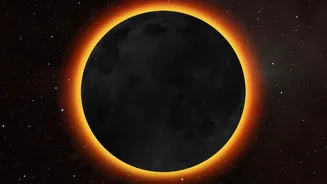
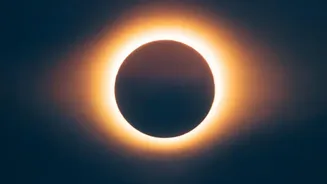
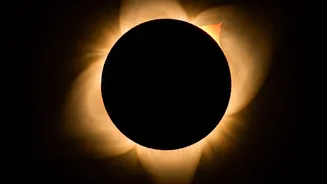
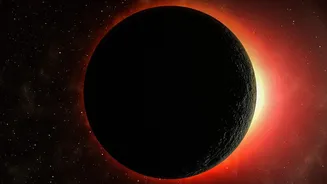
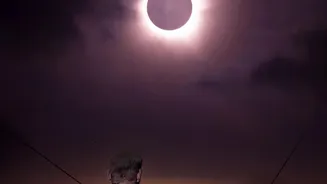
When the demon Svarbhanu disguised himself as a god to steal a sip, he was spotted by Surya (the Sun) and Chandra (the Moon). Lord Vishnu, in his Mohini avatar, swiftly beheaded the demon, but not before the nectar had touched his throat, making his head and body immortal. The head, now called Rahu, and the body, Ketu, became shadowy celestial entities. To exact revenge on the Sun and Moon for exposing him, Rahu periodically swallows them, causing an eclipse. Since Rahu has no body, the Sun or Moon eventually emerges, ending the darkness. This single, powerful myth provides the common cultural and spiritual context for why eclipses are considered significant across almost all Hindu traditions.
The Common Code: Sutak, Snan, and Daan
Despite variations, a general set of rituals is widely observed. Central to this is the concept of 'Sutak', an inauspicious period that begins several hours before the actual eclipse. For a solar eclipse, Sutak is typically observed for 12 hours (four prahars), and for a lunar eclipse, it's 9 hours (three prahars). During this time, many Hindus avoid cooking, eating, and drinking. Temples often close their doors, and idols may be covered. Activities like starting new ventures or even cutting nails are discouraged. The eclipse period itself is considered a powerful time for spiritual practices like chanting mantras, with the Mahamrityunjaya and Vishnu Sahasranama being popular choices. After the eclipse, a purifying bath (snan) is essential, followed by cleaning the house and making donations (daan), which is believed to multiply spiritual merit.
North vs. South: A Tale of Two Calendars
One of the most significant sources of variation is the regional difference, particularly between North and South India. These differences often stem from the use of different almanacs, or 'Panchangs'. North India predominantly follows the Purnimanta calendar, which marks the end of a lunar month on the full moon (Purnima). In contrast, the South follows the Amanta system, where the month ends on the new moon (Amavasya). This can lead to differences in the calculation and timing of the Sutak period. Furthermore, local traditions play a huge role. For instance, in some South Indian traditions, the Sutak period may be observed more strictly or begin earlier, while certain North Indian family traditions (Kulachara) might dictate unique fasting rules. The deities worshipped and the specific mantras chanted can also vary based on regional and community customs.
Scriptures, Sects, and Family Traditions
Hinduism is not a monolithic religion with a single, central authority. Its strength lies in its diversity, which is reflected in eclipse rituals. While foundational texts like the Puranas provide the mythological basis, other scriptures like the Dharmasindhu offer detailed instructions on rituals. However, these are often layered with practices from various 'sampradayas' (sects or traditions) and Agamic (temple-focused) texts. Some traditions may place greater emphasis on the astrological impact of an eclipse, advising specific rituals based on an individual's zodiac sign to mitigate 'Grahan Dosha' or the negative influence of the eclipse. Over time, these scriptural injunctions blend with folk beliefs and 'Kulachara' (family-specific customs) passed down through generations. This creates a rich and varied tapestry where one family may observe a strict fast while another focuses solely on chanting and post-eclipse charity.