



The Elusive Cosmic Messenger
Trillions of particles called neutrinos pass through your body every second, completely unnoticed. Often called 'ghost particles', they have almost no mass, no electric charge, and barely interact with matter. This quality allows them to travel in a straight
line for billions of light-years, zipping through planets, stars, and entire galaxies as if they were empty space. While most neutrinos originate from relatively low-energy sources like our own Sun, some are born in the most violent and energetic events in the universe. For decades, the precise origin of these high-energy neutrinos has been a major astronomical mystery. Because they travel unimpeded, they are perfect cosmic messengers, carrying information directly from the heart of cosmic engines that are otherwise hidden from view.
An Icy Trap at the South Pole
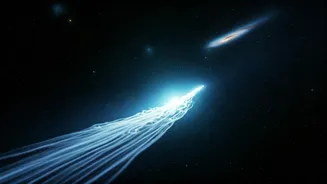
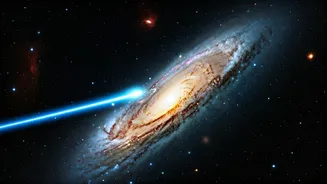
Detecting these particles is a monumental challenge. To catch one, scientists built the IceCube Neutrino Observatory, a massive detector buried a kilometre deep in the Antarctic ice. It consists of over 5,000 light sensors suspended in a cubic kilometre of pristine, clear ice. On the rare occasion that a high-energy neutrino collides with an atom in the ice, it creates a faint flash of blue light. By mapping this flash, scientists can reconstruct the particle’s energy and its original direction of travel. In September 2021, IceCube detected just such an event: a high-energy neutrino dubbed IC 210922A, arriving from the direction of the constellation Eridanus.
Meet the 'Shadow Blaster'
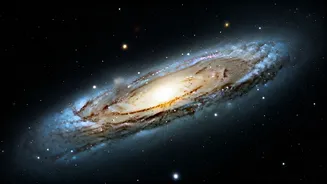
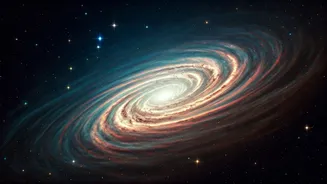
The IceCube alert sent astronomers around the world scrambling to find the source. But initial searches with optical and X-ray telescopes found nothing unusual. A team led by Yuji Urata of MITOS Science Co. then pointed other telescopes, which observe longer wavelengths of light, toward the area. They discovered an object that was invisible in normal light but blazed brightly in submillimeter wavelengths: a galaxy nicknamed 'Shadow Blaster'. Officially known as JCMT0402â’0424, this galaxy is 11 billion light-years away and heavily obscured by cosmic dust. The light from this event has been traveling since the universe was just a few billion years old.
A Different Kind of Cosmic Engine
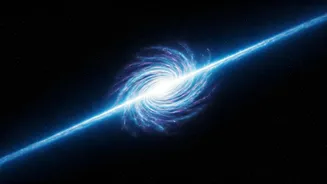
Previously, the only confirmed source of a high-energy neutrino from beyond our galaxy was a 'blazar'—a galaxy with a supermassive black hole at its core that shoots a jet of particles directly at Earth. Scientists initially suspected Shadow Blaster might be another blazar, but observations showed no sign of an active, feeding black hole. Instead, they found an extremely compact core, just 1,500 light-years across, undergoing an intense burst of star formation. This discovery provides the first strong evidence that these 'starburst' galaxies, not just those with monstrous black holes, can act as powerful particle accelerators, creating the conditions needed to launch high-energy ghost particles across the universe.
A New Chapter in Astronomy
While the connection is not yet definitive, Shadow Blaster is the most plausible candidate for the source of the neutrino event. This potential link marks a significant step forward for 'multi-messenger astronomy', a new field that combines information from different cosmic signals—like light, gravitational waves, and particles like neutrinos—to get a more complete picture of the universe. Light can be blocked by dust, but neutrinos are not. By following the path of this ghost particle, astronomers were able to find a galaxy that might otherwise have remained hidden. This success suggests that a whole population of dusty, star-forming galaxies could be responsible for a significant portion of the high-energy neutrinos that pepper the cosmos.