



1. Mehrangarh Fort, Jodhpur
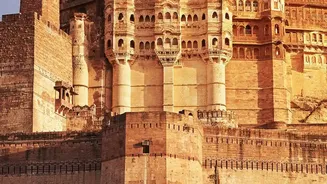
Rising 400 feet above the city of Jodhpur, Mehrangarh Fort is an awe-inspiring sight. Built in the 15th century, its imposing walls seem to grow organically from the rocky cliff they stand on. The true visual adventure lies within: expansive courtyards
lead to intricately carved palaces like the Moti Mahal (Pearl Palace) and Phool Mahal (Flower Palace). The delicate latticework of the jalis, or stone windows, creates a dramatic play of light and shadow, while the ramparts offer breathtaking panoramic views of Jodhpur’s famous “Blue City” below.
2. Amer Fort, Jaipur
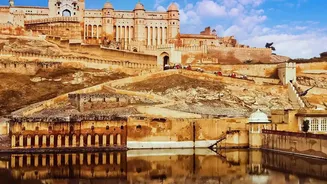
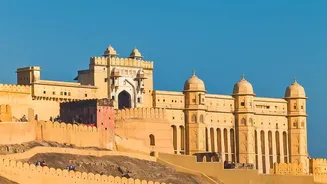
Overlooking Maota Lake, Amer Fort is a stunning blend of Rajput and Mughal architectural styles. Constructed from pale yellow and pink sandstone and white marble, the fort’s opulent appearance is captivating. The journey through its four levels reveals courtyards, gardens, and palaces. The highlight is the Sheesh Mahal, or Mirror Palace, where thousands of tiny mirrors are embedded in the walls and ceilings, designed to glitter like stars from a single flame. This intricate craftsmanship makes Amer a truly magical experience.
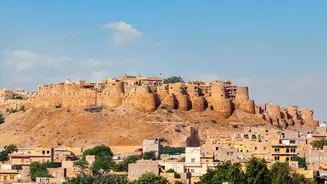
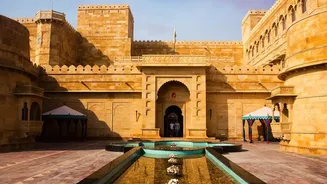
3. Jaisalmer Fort, Jaisalmer
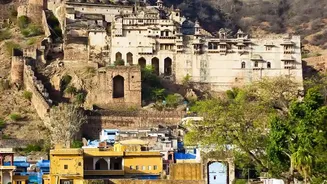
Unlike most forts, which are now museums, Jaisalmer Fort is a “living fort.” Nearly a quarter of the old city's population still resides within its golden sandstone walls, making it a unique cultural and visual experience. Built in 1156, the fort, also known as Sonar Quila or the Golden Fort, seems to rise from the Thar Desert like a mirage. Wandering through its narrow, winding lanes, you'll discover ancient havelis, bustling markets, and Jain temples, all while daily life unfolds around you. The fort glows with a honey-gold hue at sunset, creating an unforgettable spectacle.
4. Chittorgarh Fort, Rajasthan
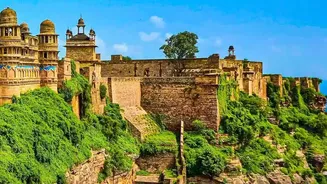
As one of the largest forts in India, Chittorgarh is a UNESCO World Heritage Site that sprawls across a 180-metre-high hill. Its history is a powerful saga of Rajput valour and sacrifice. The vast complex contains palaces, temples, memorials, and impressive victory towers, the Vijay Stambh being a prime example. The fort's sheer scale is a visual adventure in itself, with massive ramparts enclosing historic structures like Rani Padmini's Palace and the Gaumukh Reservoir. From its walls, you don't just see a landscape; you feel the weight of centuries of history.
5. Golkonda Fort, Hyderabad
Once the capital of the Qutb Shahi dynasty, Golkonda is renowned for its formidable structure and ingenious engineering. The fort is famous for its acoustics; a clap at the main gate, the Fateh Darwaza, can be heard at the highest point almost a kilometre away. This acoustic marvel served as a warning system. A climb to the top rewards visitors with a bird's-eye view of the ruins of palaces, mosques, and the surrounding city. Once a hub of the world's diamond trade, which famously housed the Koh-i-Noor, the fort's evening light and sound show brings its glorious past to life.
6. Kangra Fort, Himachal Pradesh
Believed to be the oldest fort in India, Kangra Fort stands majestically in the Himalayan foothills. Built by the Katoch dynasty, it is the largest fort in the Himalayas and overlooks the confluence of the Banganga and Manjhi rivers. The journey through its massive gates reveals ancient temples and weathered ramparts. The true visual splendour, however, is the panoramic view of the snow-capped Dhauladhar mountain range, which provides a stunning backdrop to this ancient stronghold. Though damaged by an earthquake in 1905, its grandeur remains palpable.
7. Gingee Fort, Tamil Nadu
Often called the “Troy of the East” for its impregnability, Gingee Fort is one of South India's most spectacular, yet underexplored, treasures. The complex is spread across three fortified hillocks: Rajagiri, Krishnagiri, and Chandrayandurg. A climb up the stone-cut steps of Rajagiri hill is a trek through history, passing granaries, audience halls, and temples. The reward for the climb is a breathtaking 360-degree view of the surrounding countryside. The seven-storey Kalyana Mahal is a standout architectural gem within the complex.