






The Usual Suspect: Turbulence
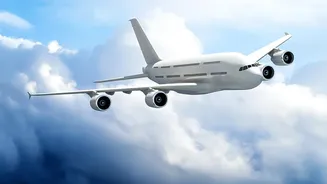
The most common reason for that stomach-lurching drop is turbulence. Think of the air as a fluid, much like a river. It can have smooth currents and chaotic eddies. When an aircraft flies through these disturbed pockets of air, it gets bumped around.
This can be caused by weather systems like thunderstorms, where powerful updrafts and downdrafts churn the atmosphere. Pilots use advanced weather radar to detect these areas of precipitation and turbulence, allowing them to plot a course around the worst of it. However, not all turbulence is visible.
Clear-Air Turbulence: The Invisible Force
Perhaps the most unsettling type is Clear-Air Turbulence, or CAT, because it occurs in cloudless, clear skies. CAT is often found at high altitudes of 23,000 to 39,000 feet, right where commercial jets cruise. It's created when two large air masses moving at very different speeds meet. A prime example is near the jet stream, a fast-moving river of air circling the globe. The friction between the fast jet stream and the slower surrounding air creates invisible waves and eddies. Flying into one of these can feel like a car hitting a sudden pothole. While it can be startling, pilots are trained to handle it, often by simply changing altitude to find a smoother layer of air.
Mountain Waves: Nature's Rollercoaster
If you're flying over a mountain range, you might experience another phenomenon known as mountain waves. When strong wind flows over a mountain, it creates ripples in the atmosphere on the downwind side, much like water flowing over a rock in a stream. These atmospheric waves can extend thousands of feet into the air and cause aircraft to be pushed up and down. Pilots are well aware of this effect and plan their routes accordingly, but sometimes encountering these waves is unavoidable. The resulting vertical currents can cause the aircraft to gain or lose altitude, which the autopilot or pilot will correct, leading to that 'dropping' sensation.
Not a Drop, But a Deliberate Descent
Sometimes, what feels like a sudden drop is actually a controlled, intentional maneuver by the flight crew. Air Traffic Control (ATC) might instruct a pilot to descend to a new altitude to maintain safe separation from other aircraft. This can require a quicker descent than the gradual one passengers are used to. Similarly, pilots might need to change altitude to avoid weather systems or find more favourable winds. What feels abrupt in the cabin is a standard procedure in the cockpit. The sensation can also be perception; after a steep climb during takeoff, the transition to level cruising flight can feel like a drop even when the plane is still climbing, just less rapidly.
Built to Withstand the Bumps
The most important thing to remember is that modern aircraft are incredible feats of engineering, designed and tested to withstand forces far greater than they would ever encounter in even severe turbulence. Wings are built to be flexible, allowing them to absorb the stress of turbulent air. When turbulence is encountered, pilots may slow the aircraft to a specific 'turbulence penetration speed' to reduce stress on the airframe and ensure a smoother ride. Their goal is not to fight the turbulence but to manage the aircraft's path through it safely. So while the bumps might be uncomfortable, they rarely pose a threat to the structural integrity of the plane.