





A World More Alive Than We Knew
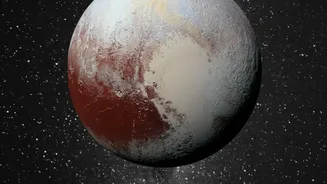
For decades, Pluto was little more than a faint point of light in our most powerful telescopes. It was easy to imagine it as an inert, frozen world, locked in a deep freeze billions of kilometres from the Sun. That perception was radically altered in 2015
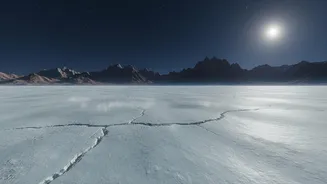
when NASA's New Horizons spacecraft flew past, revealing a world of stunning complexity. It had vast glaciers, towering mountains of water ice, and an unexpectedly thin but complex atmosphere. But the biggest surprise was the evidence of ongoing geological activity. The surface, in some places, was remarkably young and free of craters, a clear sign that something was actively reshaping it.
The Beating Heart of Pluto
At the centre of this mysterious activity is Sputnik Planitia, the western lobe of Pluto's famous heart-shaped feature, Tombaugh Regio. This enormous basin, larger than Texas and Oklahoma combined, is not solid ground but a colossal glacier made primarily of frozen nitrogen. New analysis of the New Horizons data, led by researchers at the Southwest Research Institute, focuses on strange dark lines and patches seen at the northern edge of this glacier. These features trace the boundaries of city-sized convection cells in the ice, and their appearance strongly suggests they were recently wetted by a liquid before freezing again.
How Nitrogen Behaves Like Lava
So, where would this liquid come from? Pluto's atmosphere is far too cold and thin for nitrogen rain to be possible. Instead, scientists propose a fascinating mechanism happening deep beneath the surface. Computer models suggest that the immense pressure from several kilometres of overlying nitrogen ice could be enough to melt the nitrogen at the very bottom of the glacier. This liquid nitrogen, being less dense than the solid ice above it, would become buoyant. Driven by this buoyancy and pressure from below, the liquid would be forced upwards through cracks and conduits in the ice sheet, much like magma pushing its way through Earth's crust.
An Eruption in the Outer Solar System
When this subsurface liquid nitrogen reaches the surface, it would briefly flow across the frozen landscape before solidifying in the extreme cold. This temporary wetting process would darken the surface, creating the distinct lines and patches observed by New Horizons. To confirm their hypothesis, scientists compared the Pluto images to those of Greenland's ice sheet taken by the Landsat 9 satellite. On Earth, meltwater creates similarly dark, wetted paths across ice and snow, strengthening the case that a liquid process is at work on Pluto. This marks the first strong evidence of recently flowing liquid on the dwarf planet's surface.
Redefining a 'Living' Planet
The implications of this discovery are profound. It suggests that Pluto is not a dead world but a geologically active one, with ongoing processes that could reshape its features over time. This activity is a form of cryovolcanism, where icy slush or liquids erupt instead of molten rock. The existence of enough internal heat to melt nitrogen ice also raises tantalizing questions about what else might be lurking beneath the crust. Some theories suggest that this heat could be enough to sustain a vast subsurface ocean of liquid water. This finding forces us to reconsider the conditions required for geological activity, suggesting that even small, distant worlds can remain dynamic for billions of years after their formation.