





A Journey to the Solar System’s Past
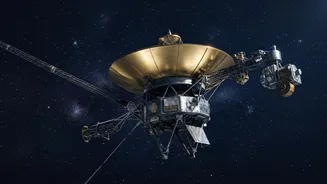
Named after the famous fossilized human ancestor, the Lucy mission is on a 12-year journey to study these unique asteroids. Scientists believe the Trojans are 'fossils of planet formation', remnants from the primordial material that formed the outer planets
more than four billion years ago. By studying them up close, researchers hope to unlock vital clues about the history of our solar system and perhaps even the origins of organic material on Earth. This new milestone means the spacecraft is now officially operating in the same neighbourhood as its primary targets.
What Are Trojan Asteroids?
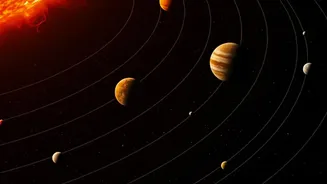
The Trojan asteroids are two large swarms of space rocks that share Jupiter's orbit around the Sun. One group, known as the 'Greek camp', travels about 60 degrees ahead of the gas giant. The other, the 'Trojan camp', trails about 60 degrees behind. They are held in these relatively stable positions, called Lagrange points, by the combined gravitational pull of the Sun and Jupiter. For billions of years, these 'islands of stability' have collected a diverse population of ancient objects, making them a pristine time capsule for scientists to explore.
A Long and Winding Road
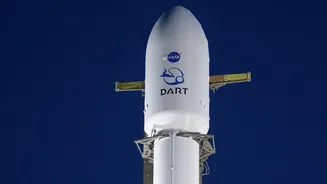
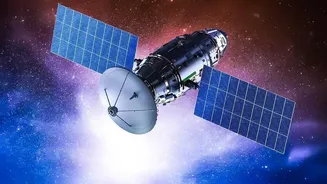
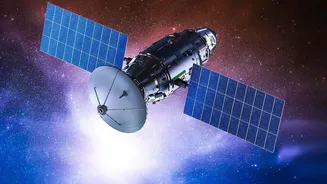
Launched on October 16, 2021, Lucy has had an eventful journey. Shortly after launch, mission engineers had to troubleshoot one of its large, circular solar arrays which failed to fully deploy, but they successfully devised a way to secure it. The spacecraft has also performed several gravity-assist flybys of Earth to build up speed for its long trek. On its way to the Trojans, Lucy also had some bonus encounters. In November 2023, it flew past the main-belt asteroid Dinkinesh and discovered it had a small satellite, now named Selam. Then, in April 2025, it studied another main-belt asteroid, Donaldjohanson. These encounters served as crucial tests for the spacecraft's instruments and navigation systems.
The Main Event Begins
Now that Lucy has entered the leading Trojan swarm, it is preparing for its first close encounter in this region. The spacecraft is so far from its targets that they still appear as mere pinpricks of light against the stars. That will change on August 11, 2027, when Lucy is scheduled to fly past its first Trojan target, Eurybates, and its satellite Queta. This will be followed by encounters with Polymele in September 2027, Leucus in April 2028, and Orus in November 2028. During these brief, highspeed flybys, Lucy's suite of scientific instruments will analyse the asteroids' geology, composition, and physical properties.
What Happens Next?
Lucy's tour is far from over after it studies the leading swarm. The spacecraft is planned to return toward Earth for a final gravity assist in 2030. This maneuver will slingshot it across the solar system toward Jupiter's trailing L5 Trojan camp. In March 2033, Lucy will conduct its final planned flyby, visiting the binary asteroid pair Patroclus and Menoetius. By visiting a record number of asteroids across both swarms, the mission aims to understand the diversity of these ancient objects and piece together a more complete picture of how our planetary system came to be.