



A Disturbance in the Stars
Imagine looking at a calm lake and seeing a powerful, invisible whirlpool churning the water into a frenzy. Astronomers recently witnessed the cosmic equivalent of this. Near the bustling centre of our Milky Way galaxy, a gigantic cloud of molecular gas,
seemingly unremarkable at first glance, was found to be behaving erratically. The gases within it are swirling with an incredible range of speeds, far faster and more chaotically than any known laws of physics would permit for a simple cloud. This bizarre motion sent a clear signal to researchers: something unseen, but immensely powerful, must be hiding inside, stirring the pot with its immense gravitational force. This wasn't a case of a star being born or a supernova explosion; the evidence pointed to something far more massive and mysterious.
The Hunt for an Invisible Giant
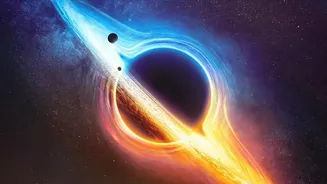
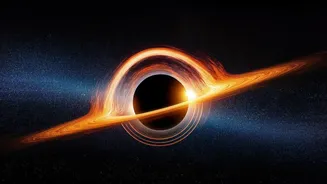
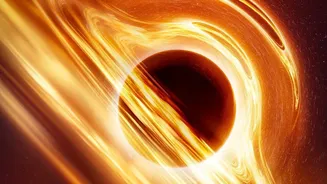
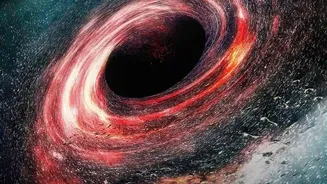
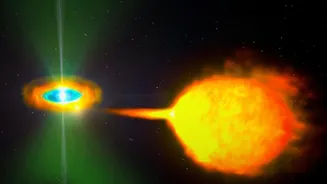
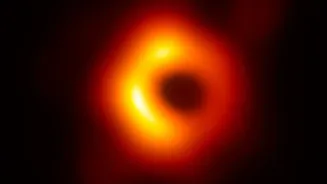
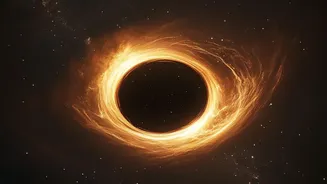
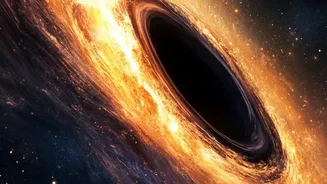
The prime suspect is a special kind of object long theorised but incredibly difficult to find: an intermediate-mass black hole (IMBH). Black holes come in two well-known sizes. There are 'stellar-mass' ones, which are up to a few dozen times the mass of our Sun, formed from the collapse of giant stars. Then there are the supermassive black holes, titans that are millions or even billions of times our Sun's mass and reside at the heart of most galaxies, including our own Sagittarius A*. The IMBH is the 'missing link' between these two extremes, weighing in at anywhere from 100 to 100,000 solar masses. Because they don't emit light, finding one is a true cosmic detective story. Scientists can't see the black hole itself, only the dramatic effects of its gravity on everything around it.
Cosmic Detective Work
To investigate this peculiar gas cloud, a team of astronomers, primarily from Japan's Keio University, used powerful radio telescopes like the Atacama Large Millimeter/submillimeter Array (ALMA) in Chile. These instruments allowed them to map the motion of the gas with incredible precision. By running complex computer simulations, they tested various scenarios to explain the gas's strange dance. Their models showed that the movements could be perfectly recreated if a compact, invisible object with a mass of around 100,000 Suns was lurking at the cloud's centre. This provided the strongest evidence to date for a quiet IMBH in our galaxy, found not by seeing it, but by observing the gravitational chaos it leaves in its wake.
Solving a Galactic Growth Spurt
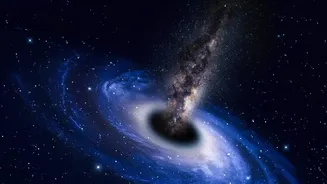
The discovery is more than just a curiosity; it could solve one of the biggest puzzles in astrophysics: how do supermassive black holes get so big? It's hard to explain how they could have grown to such monstrous sizes in the early universe just by consuming gas and stars alone. One leading theory suggests they grew by merging with and consuming these 'mid-sized' IMBHs. Finding an IMBH candidate just 200 light-years from the Milky Way's own supermassive black hole is a major breakthrough. It suggests these cosmic seeds might be more common than we thought, and that our galaxy's central giant may have grown by swallowing smaller black holes just like this one over billions of years.
The Dawn of 'Black Hole Stars'
This method of finding hidden black holes is opening a new frontier. Even more recently, observations with the James Webb Space Telescope (JWST) have revealed similar phenomena in the very distant, early universe. Astronomers have spotted mysterious, ultra-bright 'little red dots' that appear to be a new type of object entirely: a 'black hole star'. These are thought to be young, growing black holes, about 100,000 times the sun's mass, completely enveloped in a thick cocoon of hydrogen gas. The black hole's intense energy heats the gas from within, causing the entire cocoon to glow like an enormous, super-bright star. These discoveries suggest that black holes hiding within gas clouds might be a fundamental step in the evolution of galaxies.