



A Cosmic Lion's Roar
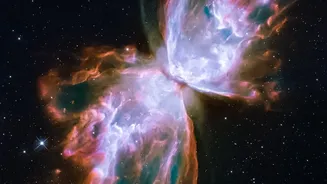
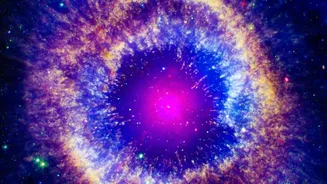
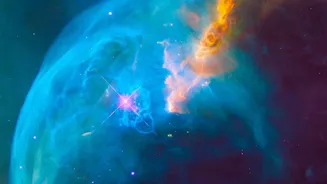
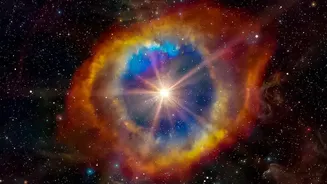
The new images showcase NGC 2392, popularly nicknamed the Lion Nebula because its swirling gas and dust resemble a lion's head and mane. At the center, like a bright nose, sits the hot, dense core of the original star, now a white dwarf. This stellar
remnant is fiercely blasting radiation into space, sculpting the material around it. The composite image, combining data from Webb's Near-Infrared Camera (NIRCam) and Mid-Infrared Instrument (MIRI), reveals a complex structure of bubbles, shells, and delicate filaments in brilliant cyan, magenta, and purple hues. What appears as the lion's 'face' is a bubble of superheated, ionized gas, while the 'mane' is a cooler, intricate ring of dust and gas adorned with comet-like streamers.
The Story of a Dying Star
Located roughly 4,200 to 6,500 light-years away in the constellation Gemini, NGC 2392 is a planetary nebula. The name is a historical misnomer from when these objects looked like planets through early telescopes. In reality, they are the final, beautiful act for stars similar to our own Sun. When a star of this size exhausts its nuclear fuel, it becomes unstable and sheds its outer layers. These layers of gas and dust expand into space, pushed and illuminated by the powerful winds and radiation from the hot stellar core left behind. The entire structure we see today has taken thousands of years to form and will continue to expand and evolve, eventually dispersing into the cosmos in about 10,000 years, a relatively brief period on an astronomical scale.
What Webb Sees That Hubble Couldn't
While NASA's Hubble Space Telescope gave us breathtaking visible-light images of this nebula in 2000, Webb's infrared vision pierces through the cosmic haze to reveal what was previously hidden. At first glance, the overall structure looks similar, but Webb's high-resolution instruments distinguish new features. The infrared view is especially adept at highlighting the distribution and temperature of dust. Webb has brought into focus dense, clumpy filaments of dust that have survived the onslaught of radiation from the central star. These durable clumps, appearing as fluffy purple structures in the new images, actually protect the material lying behind them, creating long, comet-like tails streaming away from the star. This allows scientists to study the intricate dance between destruction and survival in a star's final moments.
Unlocking Secrets of Stellar Evolution
This detailed portrait of the Lion Nebula is more than just a pretty picture; it's a scientific treasure trove. It provides a snapshot of the processes that enrich the universe with heavier elements and complex materials. By studying how the central star’s powerful winds and radiation interact with the ejected material, astronomers can better understand the final life stages of the vast majority of stars in the cosmos, including the eventual fate of our Sun in about five billion years. The complex rings and shells are common features in planetary nebulae, but the reasons for their intricate structures are still an active area of research. Images like this, which show the survival of dusty filaments amidst a destructive blast of energy, provide crucial data for refining models of stellar evolution and how dying stars seed the next generation of cosmic creation.