






A Telescope That Sees Twisted Light
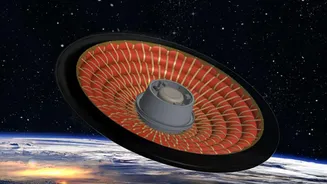
Launched in late 2021, NASA’s Imaging X-ray Polarimetry Explorer (IXPE) has a unique job. It doesn’t just take pictures of cosmic objects; it measures the polarization of the X-rays they emit. Polarization is the orientation of light waves as they travel.
Think of it like looking through polarized sunglasses—they block glare by filtering out light waves that are aligned in a certain direction. By measuring the degree and direction of X-ray polarization, IXPE allows scientists to map out the invisible magnetic fields and extreme physics at play in some of the universe's most violent environments. It gives them a new dimension of information that was previously inaccessible.
Staring at the Universe's Strongest Magnets
To test some of the wildest theories in physics, you need a laboratory that can’t be built on Earth. For this study, scientists pointed IXPE at a magnetar known as 1E 1547.0-5408. Magnetars are a type of neutron star, the super-dense collapsed cores of giant stars. What makes them special are their magnetic fields, which are the strongest known in the universe—trillions of times more powerful than anything humans can create. This immense magnetic field makes the space around a magnetar the perfect place to hunt for a bizarre quantum phenomenon.
The Spooky Idea of Vacuum Birefringence
In 1936, physicists Werner Heisenberg and Hans Euler proposed a strange consequence of quantum electrodynamics (QED), the theory governing how light and matter interact. They predicted that a vacuum—what we think of as empty space—is actually buzzing with a sea of 'virtual' particles and anti-particles that constantly pop in and out of existence. Under normal conditions, their effects cancel out. But in the presence of an incredibly strong magnetic field, like a magnetar's, this quantum vacuum should become polarized. The space itself would gain a 'grain,' causing it to act like a crystal. This effect, called vacuum birefringence, predicts that light polarized in one direction will travel at a slightly different speed than light polarized in another, twisting the light as it passes through.
What IXPE Actually Discovered
After observing the magnetar for over 140 hours in 2025, IXPE detected a surprisingly high degree of polarization in the X-rays—nearly three times greater than what standard models would predict for such an object. The polarization signal was also incredibly smooth and coherent as the star rotated. When researchers ran computer simulations, they found they could not reproduce this unusually strong signal based on emissions from the star's surface alone. However, when they added the effects of vacuum birefringence to their models, the simulations suddenly matched the observations almost perfectly. The intense magnetic field was acting as a cosmic filter, just as the 90-year-old theory predicted.
Why It Matters for Physics
While scientists are careful to state that this isn't yet absolute proof, it is the strongest and most direct evidence for vacuum birefringence to date. The finding is significant for several reasons. First, it helps validate QED in a strong-field regime where it has never been tested before. Second, it gives astronomers a powerful new tool to understand the geometry and physics of magnetars. But most profoundly, it provides compelling support for the idea that the fabric of reality is far stranger than it appears. The observations from a distant, dead star are helping to confirm a fundamental law about the nature of space itself. Further observations are planned to solidify the findings, but it's a major step in a quest that began nearly a century ago.