







First, Perfect the Classic Plank
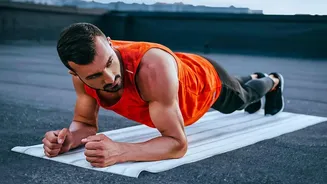
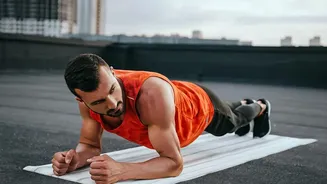
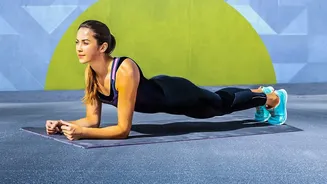
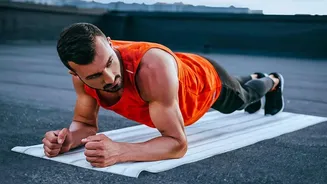
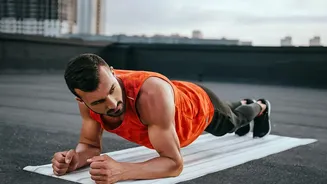
Before exploring variations, it is crucial to master the standard plank. Proper form is everything; it ensures you get the maximum benefit while preventing injury. Start on all fours, then extend your legs back, resting on your toes. Your hands should
be directly under your shoulders. Your body must form a straight line from your head to your heels. Avoid letting your hips sag or rise too high, as this can strain your lower back or reduce core engagement. Engage your core by pulling your belly button towards your spine, keep your neck neutral by looking at the floor, and breathe steadily. A solid 30- to 60-second hold is a great foundation before adding complexity.
Side Plank for Oblique Strength
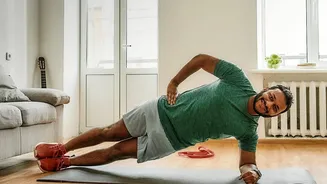
Long hours at a desk can weaken the muscles that support your spine. The side plank specifically targets the obliques, which are vital for rotational stability and protecting your lower back. To perform it, lie on your side with your legs straight and stacked. Place your forearm on the floor with your elbow directly under your shoulder. Engage your core and lift your hips until your body forms a straight line from your head to your feet. You can raise your top arm toward the ceiling for added balance. For an easier modification, you can perform the exercise from your knees instead of your feet. Hold for 30 seconds on each side.
Plank with Shoulder Taps to Challenge Stability
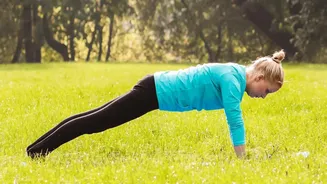
This variation introduces a dynamic challenge, forcing your core to work harder to prevent your hips from rotating. It’s an excellent way to improve balance and control. Begin in a high plank position with your hands under your shoulders and feet slightly wider than hip-width for a more stable base. Keeping your core tight and your body as still as possible, lift your right hand and tap your left shoulder. Return your right hand to the floor and repeat on the other side, tapping your right shoulder with your left hand. The key is to move slowly and deliberately, minimising any rocking motion in your hips.
Walking Plank (Up-Downs) for Full-Body Engagement
Also known as the Commando Plank, this move adds a cardio element and works your chest, shoulders, and triceps alongside your core. Start in a forearm plank position. One arm at a time, push up into a high plank (on your hands). Then, lower back down one arm at a time to the starting forearm plank position. Try to alternate which arm you lead with to ensure balanced muscle development. To make it easier, you can perform this move on your knees, which reduces the strain while still providing a great upper-body workout.
Reverse Plank to Counteract Slouching
We spend most of our days hunched forward. The reverse plank is a fantastic counter-movement that strengthens the often-neglected posterior chain: your glutes, hamstrings, and lower back. Sit on the floor with your legs extended in front of you. Place your hands on the floor behind you, fingers pointing toward your feet. Engage your glutes and core to lift your hips off the ground until your body forms a straight line from your heels to your shoulders. Keep your arms and legs straight and focus on squeezing your glutes to maintain the lift. This move not only builds strength but also helps open up your chest and shoulders, improving posture.
Lateral Plank Walk for Coordination
This exercise challenges your core’s ability to resist rotation while moving sideways. Start in a high plank position. Simultaneously step your left hand and left foot out to the side. Then, bring your right hand and right foot to meet them, returning to your starting plank stance but shifted to the side. The goal is to keep your plank rigid and your hips square to the floor throughout the movement. Take four or five steps in one direction, then reverse and walk back to the other side. This move requires concentration and control, making it a powerful tool for building functional core strength.