



Our Cosmic Next-Door Neighbour
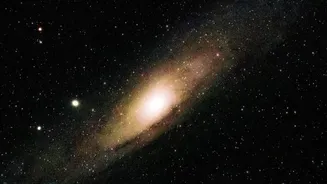
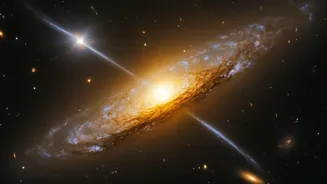
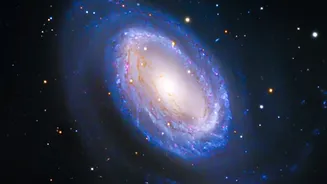
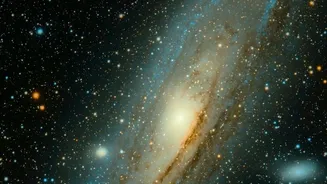
At a distance of 2.5 million light-years, the Andromeda galaxy (M31) is practically in our cosmic backyard. It is the closest major spiral galaxy to our own Milky Way and is even visible to the naked eye from dark-sky locations. But its proximity is not
just a curiosity; it makes Andromeda a crucial natural laboratory. Because we are situated inside the Milky Way, we can never get a complete, outside view of our own galaxy. Andromeda offers astronomers the next best thing: a similar spiral galaxy that we can observe from a perfect bird's-eye perspective, allowing us to study the grand architecture of a galaxy like ours in stunning detail.
Hubble's Unprecedented View
To unlock Andromeda's secrets, astronomers turned to the Hubble Space Telescope. Its sharp vision is essential because, even though Andromeda is close, resolving its individual stars is an immense challenge. A massive undertaking called the Panchromatic Hubble Andromeda Treasury (PHAT) survey, along with its southern counterpart PHAST, dedicated years to meticulously mapping large swathes of the galaxy. These projects combined thousands of images to create a gigantic mosaic, resolving the light of approximately 200 million individual stars. According to Ben Williams, an astronomer at the University of Washington, these stars are the "fossil record of the galaxy's formation," and Hubble is the only telescope capable of reading it with such clarity across such a vast area.
A Story Written in Starlight
By analysing the colour and brightness of these millions of stars, scientists can act as galactic archaeologists. Massive stars burn hot, shine blue, and have very short lives, indicating regions of recent star birth. Smaller, less massive stars have cooler, redder light and can live for billions of years, marking older, more settled populations. By dividing the galaxy into thousands of sections and analysing the stellar populations within each, researchers can reconstruct the history of star formation across space and time. This detailed analysis revealed a major burst of star formation in Andromeda about 2 billion years ago, likely triggered by a merger with a smaller galaxy. Since then, however, its star-making activity has been on a long, steady decline.
A Galaxy Winding Down
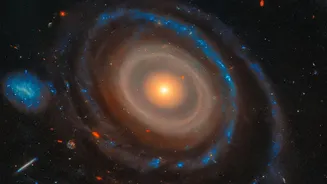
The latest findings from the Hubble studies show that this decline has been significant. Around 500 million years ago, Andromeda was forming stars at a rate of about one solar mass per year. By 40 million years ago, that rate had dropped by half. Today, it has plummeted to about one-fifth of a solar mass per year. This slowdown isn't happening uniformly. Much of the recent star-making has been concentrated in a distinct ring about 32,000 light-years from the galactic centre. The fading activity in this ring is a major driver of the galaxy's overall decline. This suggests Andromeda is not running out of the raw gas needed for star birth, but is rather in a natural phase of winding down after a more active past.
Clues to Our Own Future
Studying Andromeda's life cycle provides a crucial template for understanding the evolution of large spiral galaxies, including the Milky Way. Its history appears more dynamic than our own, possibly due to a more turbulent history of galactic mergers. These observations help constrain models of how galaxies grow, age, and eventually slow their creative engines. Understanding why Andromeda is quieting down helps us place our own galaxy's star-forming activity into a broader context. In about 4.5 billion years, Andromeda and the Milky Way are predicted to collide and merge, an event that will likely trigger a massive new burst of star formation. By studying our neighbour now, we get a preview of the cosmic processes that have shaped our past and will define our distant future.