



The Foundational Forearm Hold
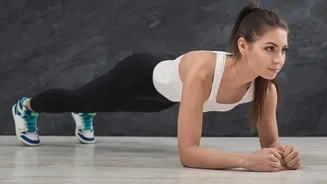
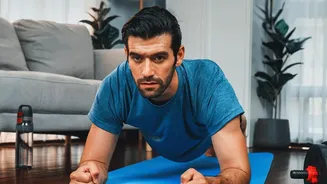
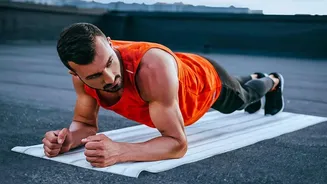
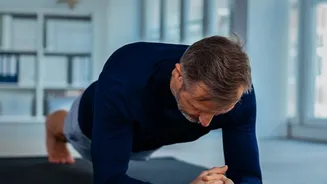
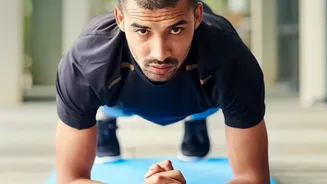
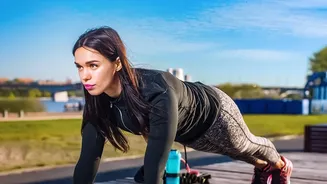
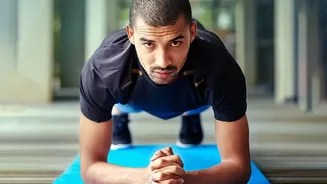
Often called a plank, the forearm hold is a masterclass in isometric strength. Unlike crunches, which involve movement, the plank challenges your core to resist gravity and maintain a stable position. To perform it, lie face down and prop yourself up
on your forearms and toes, keeping your body in a perfectly straight line from head to heels. Engage your core by pulling your navel towards your spine and squeeze your glutes. This move is exceptional for targeting the deep transverse abdominis, the muscle that acts like a natural corset for your midsection, as well as the rectus abdominis and obliques. Holding this position builds endurance and creates a solid base for more dynamic movements.
Dynamic Plank Jacks
Once you have mastered the plank, introduce a cardiovascular challenge with plank jacks. This exercise combines a plank with a jumping jack motion. Start in a high plank position, with your hands directly under your shoulders and your body straight. While keeping your core braced and your upper body still, jump your feet out wide and then back together again. This dynamic movement elevates your heart rate while challenging your core stability. It strengthens not only your abdominals and obliques but also your glutes, quadriceps, and shoulders, making it a highly efficient, full-body exercise. For a lower-impact version, you can tap one foot out to the side at a time instead of jumping.
Oblique-Focused Russian Twists
To target the muscles on the sides of your torso, the obliques, rotational exercises are key. The Russian twist is a classic and effective choice. Sit on the floor, lean your torso back to about a 45-degree angle, and lift your feet off the ground, balancing on your sit bones. Clasp your hands together and twist your torso from side to side. This movement strengthens the obliques, which are crucial for rotational power in sports and daily activities. You can make the exercise more challenging by holding a weight, like a dumbbell or medicine ball. The key is to move with control, rotating your entire upper body, not just your arms.
The Stabilising Dead Bug
The dead bug may have a strange name, but it is one of the safest and most effective exercises for developing deep core stability and coordination. Lie on your back with your arms extended toward the ceiling and your knees bent at a 90-degree angle over your hips (a tabletop position). Press your lower back gently into the floor. Slowly lower your right arm and left leg toward the floor simultaneously, moving with control until they are just hovering above it. Return to the start and repeat on the other side. This contralateral movement challenges your core to prevent your lower back from arching, strengthening the transverse abdominis and improving motor control.
The Balancing Bird-Dog
A complete core workout must also include the posterior chain—the muscles on the back of your body, like your lower back and glutes. The bird-dog exercise is perfect for this. Start on all fours in a tabletop position, with your hands under your shoulders and knees under your hips. Engage your core and extend your right arm straight forward and your left leg straight back, forming a straight line from your fingertips to your heel. Hold for a moment, keeping your hips and shoulders square to the floor, then return to the starting position and switch sides. This move enhances balance, promotes a neutral spine, and strengthens the erector spinae muscles of the back, which are vital for good posture.