






What is a Baseline Design Review?
In the world of complex engineering, a Baseline Design Review (BDR) is a pivotal moment. It's the point where a project transitions from a concept on paper to a concrete engineering blueprint. According to government statements, this review for the first
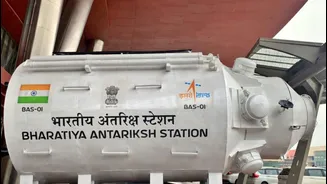
module, known as BAS-01, has been successfully completed, resulting in the release of 31 baseline design documents. An expert committee has assessed these plans, giving ISRO the green light to move on to the next phase: designing the intricate subsystems that will make the module function. This step essentially freezes the foundational architecture, ensuring that everyone involved is building towards the same, verified plan. It's less about celebrating a finish line and more about getting a powerful, official start.
The Vision: Bharatiya Antariksha Station
The BAS-01 module is just the first piece of a much larger puzzle. The full Bharatiya Antariksha Station (BAS) is envisioned as a modular orbital laboratory, which will be assembled piece by piece in low-Earth orbit, approximately 400-450 kilometres above our planet. The plan is for a five-module station to be completed by 2035. This phased approach allows for easier upgrades and flexibility over the station's lifespan. Once fully operational, the station will serve as a hub for Indian astronauts to conduct long-duration scientific experiments in microgravity, for periods extending from three to six months. This opens up new frontiers for research in biotechnology, materials science, and human physiology.
Inside the First Module: BAS-01
The first module, BAS-01, is the foundational block of the entire station. It is targeted for launch by 2028 aboard one of ISRO's powerful LVM3 rockets. This initial component is expected to weigh around 9-10 tonnes and will be crucial for the station's future. It is designed to house essential systems like crew quarters, life support, and the critical docking and berthing systems that will allow future modules and spacecraft to connect to it. The completion of its design review signals that the intricate work on its power, communication, and life support subsystems can now begin in earnest.
The Gaganyaan Connection
The space station project is deeply intertwined with India's human spaceflight mission, Gaganyaan. The Gaganyaan program, which aims to demonstrate the capability to send a crew of three into a 400 km orbit for a three-day mission and return them safely, is the essential precursor. The technologies being developed for Gaganyaan—from the human-rated launch vehicle (HLVM3) and orbital module to the crew escape system—are the building blocks for the space station. Successfully sending Indian astronauts, or 'Gaganyaatris', into space will provide the experience and technological confidence needed for the much more complex challenge of long-duration stays aboard the BAS. The space station is the logical and ambitious next step after Gaganyaan is accomplished.
Building for the Future
Beyond the module design, ISRO is also focusing on developing key technologies indigenously to ensure self-reliance. The government has approved the domestic development of critical components like flight suits, crew seats, and spacecraft docking technology, which are currently sourced from external partners for the initial Gaganyaan missions. Progress has also been reported on developing an in-orbit refuelling mechanism, a technology vital for sustaining long-term missions and supporting the future modules of the station. These initiatives will not only reduce dependency but also foster innovation and high-tech manufacturing within India, establishing the technological foundation for the remaining four modules of the BAS and future deep-space missions.