








A Lonely Listener on the Red Planet
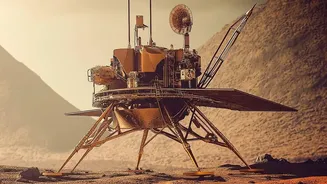
Our story begins with a silent sentinel on the Martian plains. NASA’s InSight lander, which operated on Mars from late 2018 until its retirement in December 2022, had a unique mission. Unlike rovers that explore the surface, InSight was designed to stay
put and listen. Its primary instrument was an incredibly sensitive seismometer called the Seismic Experiment for Interior Structure (SEIS). Its goal was to detect “marsquakes”—vibrations travelling through the planet—to unveil the secrets of Mars’s deep interior, from the crust and mantle all the way down to the core. Over its four-year mission, InSight recorded over 1,300 seismic events, providing a treasure trove of data that scientists are still deciphering.
Strange Tremors from a Fractured Land
Among the hundreds of quakes InSight detected, a particular cluster stood out. These quakes originated from a region known as Cerberus Fossae, a series of vast, semi-parallel fissures stretching over 1,200 kilometres. This area has long been considered one of the youngest and most volcanically active regions on Mars, with evidence of lava flows within the last few million years. But the seismic signals from this region were unusual. Most marsquakes, like earthquakes, are caused by brittle fracturing, where rocks under stress suddenly break along a fault line. The seismic waves from Cerberus Fossae, however, had a different signature, particularly at low frequencies, suggesting a different kind of geological action was at play.
The Signature of Magma on the Move
This is where the detective work began. A team of scientists closely analyzed the specific waveforms of these unique quakes. They created models to simulate different geological events and see which one best matched the signals InSight had recorded. The conclusion was startling: the best explanation wasn't rock fracturing, but rather the movement of molten rock. The data pointed to a process known as a magmatic dyke intrusion. In simple terms, this is when magma, instead of erupting from a volcano, pushes its way horizontally through cracks deep underground. This movement exerts pressure on the surrounding rock, generating the low-frequency seismic waves that InSight detected. It was the first time this process had been directly identified through seismic data on another planet.
A Planet More Active Than We Knew
The discovery of an active dyke intrusion has profound implications for how we view Mars. It strongly suggests that the planet is not geologically inert. While there might not be towering volcanoes spewing lava today, there are active magmatic systems shifting and moving miles beneath the surface. The events at Cerberus Fossae are thought to be relatively recent in geological terms, challenging the long-held image of Mars as a planet whose volcanic heart went cold billions of years ago. This underground movement of magma can also generate heat and interact with subsurface ice, potentially creating localized environments with liquid water—a key ingredient for life. The findings from InSight show that even without Earth-style plate tectonics, Mars can have a complex and dynamic interior.