



A Sweet Steeped in Mythology
The connection between Lord Ganesha and the modak is deeply embedded in Hindu mythology. Several Puranic tales explain his love for the sweet, earning him the name 'Modakapriya', or the one who loves modaks. The most popular story involves a divine modak,
which granted supreme knowledge to whoever consumed it, being presented to Lord Shiva and Goddess Parvati. A challenge was set for their sons, Ganesha and Kartikeya: whoever circled the world three times first would win the sweet. While Kartikeya set off on his peacock, Ganesha simply circled his parents, wisely stating they were his entire world. Impressed by his devotion and wisdom, Parvati awarded him the modak, forever linking the sweet to knowledge and Ganesha himself. During Ganesh Chaturthi, it's traditional to offer 21 modaks as 'naivedyam' or a sacred offering.
Searching for the Modak in Ancient Texts
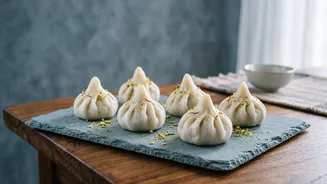
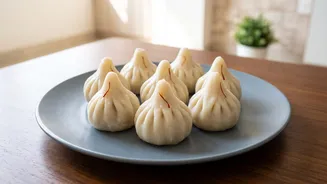
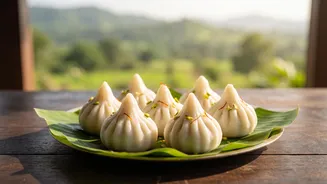
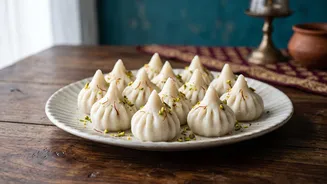
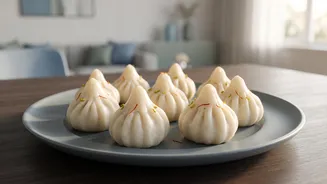
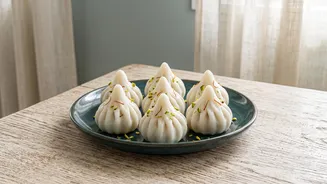
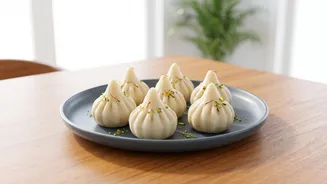
While the mythological link is strong, the historical evidence presents a more layered picture. The word 'modaka' itself is ancient, with culinary historian Darra Goldstein tracing it back to around 200 BCE. References to a sweet dumpling called modaka appear in foundational texts like the Ramayana and Mahabharata, as well as in Ayurvedic scriptures. Sangam literature, from South India, also mentions sweet, stuffed rice dumplings being sold by street vendors in the ancient city of Madurai. However, these early mentions describe a general sweet dumpling, not necessarily the specific steamed rice flour version with a coconut and jaggery filling, known today as 'ukadiche modak' in Maharashtra. The 12th-century text 'Manasollasa' describes a sweet called 'varsopalagolakas', made with rice flour and a sweet, spiced stuffing, which is believed to be a precursor.
The Story Told by Ingredients
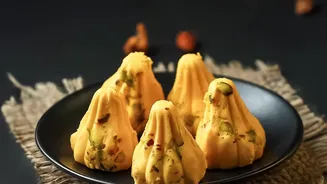
The history of the modak’s key ingredients—rice, coconut, and jaggery—offers another path to understanding its evolution. Rice cultivation in India dates back thousands of years and has always been central to rituals and food. Jaggery, a traditional non-centrifugal sugar, is also an ancient staple in the Indian subcontinent. The combination of these ingredients is particularly characteristic of coastal cuisines, especially in Maharashtra and South India, where both rice and coconut are abundant. The Maharashtrian 'ukadiche modak' is strongly tied to the Konkan coast, while fried wheat-flour versions are more common inland where rice was less of a staple. This suggests the modern modak's form is deeply connected to regional agriculture and geography.
When Did the Link Solidify?
While textual mentions of a generic modak are ancient, the visual and cultural link to Ganesha appears to have solidified over centuries. Sculptures from as early as the 6th to 8th centuries CE in places like Goa and the Ellora Caves depict Ganesha holding a bowl of sweets that resemble laddoos or modaks. This shows an early association between the deity and a round sweet. The worship of Ganesha gained significant prominence in the region of modern-day Maharashtra during the Yadava dynasty (c. 1187–1317), and he was established as the patron deity of Pune. It's likely that during this period, local culinary traditions, including the making of rice-and-coconut sweets, began to merge more formally with religious worship. The specific 'ukadiche modak' we know today likely became synonymous with Ganesh Chaturthi as the festival itself was popularized, particularly in Maharashtra.
What the Evidence Supports
So, is the modak an ancient offering to Ganesha? The evidence points to a nuanced conclusion. The idea of a sweet dumpling called a modaka is indeed ancient. The association of Ganesha with sweets is also centuries old, verified by temple sculptures. However, the specific, pleated, steamed modak filled with coconut and jaggery is more likely a later culinary development, particularly from the coastal regions of India. The tradition as we celebrate it today is a beautiful fusion of ancient belief, Puranic stories, and regional food culture that evolved over time. It’s not a static fact from a single point in history, but a living tradition that has deepened in meaning with each passing generation.