


A Galactic Mystery
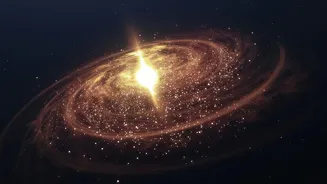
For years, astronomers were puzzled by a curious feature of the Milky Way. The main disk, where our Sun resides, spins at a brisk 220 kilometres per second. Yet the stellar halo—a vast, sparse sphere of ancient stars surrounding the disk—rotates at a surprisingly
sluggish pace of only 10 to 20 kilometres per second. This discrepancy suggested something dramatic happened in our galaxy's youth. The clues pointed towards a cataclysmic event, a defining moment in the Milky Way's history that fundamentally reshaped it long before Earth was even formed.
The Sausage-Shaped Clue
The investigation took a major leap forward in 2018, thanks to the European Space Agency's Gaia satellite, a mission designed to create an unprecedented 3D map of our galaxy. By tracking the positions and movements of billions of stars, Gaia uncovered a group of stars moving in bizarre, elongated orbits. Their strange, sausage-like trajectory was a smoking gun, pointing to their origin in a different galaxy. Astronomers realised they were seeing the shredded remains of a dwarf galaxy that had plunged directly into the Milky Way and been torn apart. Fittingly, they named the long-dead interloper the 'Gaia Sausage'.
Recreating a 10-Billion-Year-Old Collision
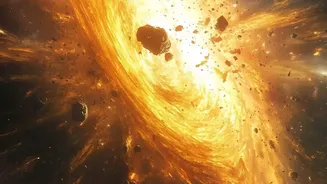
With the culprit identified, scientists at Durham University used powerful supercomputer simulations to piece together the crime. They modelled what would happen if a Milky Way-like galaxy suffered a head-on collision with a smaller galaxy like the Gaia Sausage. The results, presented in July 2026, were astounding. The simulations showed that the immense gravitational forces from such a direct hit would have created a powerful torque, slowly but surely flipping the entire galactic disk by more than 90 degrees. This colossal, slow-motion somersault, which would have taken hundreds of millions of years, perfectly explains why the surrounding stellar halo barely seems to rotate today. It preserves the memory of an ancient, violent reorientation.
A History of Cosmic Violence
The Gaia Sausage collision, which occurred roughly 10 billion years ago, was the Milky Way's last major merger and a defining moment in its evolution. It wasn't the only one, however. Our galaxy's history is peppered with smaller galactic run-ins. More recently, repeated collisions with the Sagittarius dwarf galaxy, starting around six billion years ago, are believed to have created the gentle warp we see in our galaxy's disk and may have even triggered the burst of star formation that gave birth to our own Sun. These ongoing interactions show that galaxies are not static islands but are constantly evolving through collisions and mergers.
Why This Ancient Crash Matters Today
Discovering our galaxy's tumultuous past does more than just solve an astronomical puzzle. It completely reframes our understanding of our place in the universe. It reveals that the stable, orderly galaxy we inhabit is the product of immense and violent upheaval. The very orientation of our galaxy, and the paths of stars we see in the night sky, are lingering consequences of a cosmic crash that happened billions of years before our solar system existed. This knowledge helps astronomers place the Milky Way in a broader context, understanding how galaxies across the universe are built through a chaotic process of destruction and creation.