

A Glimpse into the Recent Past
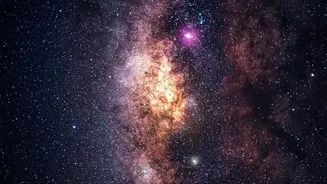
The Milky Way is ancient, around 13.6 billion years old, and most of its features are equally old. Finding an object that is considered 'young' on a cosmic scale is a rare treat for astronomers. This bright cloud is believed to be a supernova remnant,
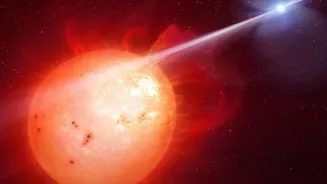
the expanding shell of gas and dust left behind after a massive star explodes. Such remnants are crucial for understanding the life cycle of stars and how heavy elements are distributed across the galaxy. Recently, a study highlighted a mysterious glow that could be from a violent collision of two neutron stars, which are incredibly dense dead stars. This event, which would have created heavy elements like gold and platinum, is also estimated to have happened less than a thousand years ago. The resulting cloud's brightness and relatively small size are key indicators of its youth.
The Cosmic Detective Work
But how can scientists tell the age of something so far away? The process is a fascinating piece of cosmic detective work. One primary method involves measuring the size of the remnant and how fast it's expanding. By observing the cloud at different points in time, astronomers can calculate its expansion velocity. They then use this speed, along with its current size, to essentially rewind the clock and estimate when the initial explosion occurred. For example, comparing images of the supernova remnant G1.9+0.3 taken by the Very Large Array radio telescope in 1985 and the Chandra X-ray Observatory in 2007 revealed it had grown significantly, confirming it was incredibly young. In fact, these observations showed it was the youngest known supernova remnant in our galaxy, at around 140-150 years old.
Why A Young Remnant Matters
Studying a young supernova remnant is like having a fresh crime scene. It offers an unparalleled opportunity to study the immediate aftermath of a star's death. These events are the primary sources of heavy elements—everything from the oxygen we breathe to the iron in our blood was forged inside stars and scattered by supernovae. A young remnant still contains pristine material from the exploded star, allowing scientists to analyse its chemical composition in detail. It also provides a unique laboratory to test theories about how the shockwave from the explosion interacts with the surrounding interstellar gas and dust, a process that can trigger the formation of new stars and planets.
A Case of Mistaken Identity?
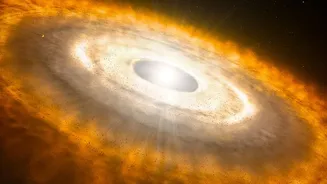
While supernova remnants are a leading candidate, other cosmic phenomena can create bright, young clouds. Some are stellar nurseries, where gas and dust are collapsing to form new stars. The James Webb Space Telescope frequently captures stunning images of these chaotic environments, where powerful radiation and jets from infant stars illuminate the surrounding gas. In other cases, a 'cloud' might not be a star-forming region at all. Researchers recently confirmed the existence of a 'failed galaxy' nicknamed Cloud-9, a massive cloud of hydrogen and dark matter that never managed to form stars. In the case of the recently studied bright cloud, researchers believe it resulted from the merger of two neutron stars, an event so powerful it would have briefly shone as brightly as Jupiter in the night sky.
Unseen by Human Eyes
One of the most intriguing aspects of this potential thousand-year-old event is that it seems to have gone unrecorded. Despite meticulous records kept by ancient astronomers, particularly in China during the Song dynasty, there is no mention of a 'guest star' in the location of this cloud. The famous Crab Nebula, for instance, is the result of a supernova recorded in 1054. Researchers suggest the flash from this more recent event might have been too brief, fading within days. Furthermore, its position far in the southern sky would have made it difficult, if not impossible, to observe from China, Japan, or Europe at the time, leaving this spectacular cosmic birth to unfold without an audience on Earth.