


Our Closest Galactic Companion
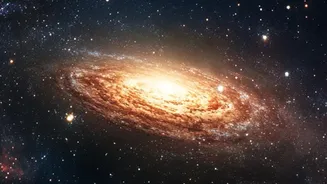
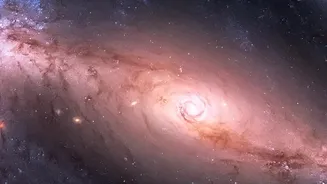
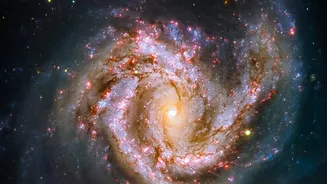
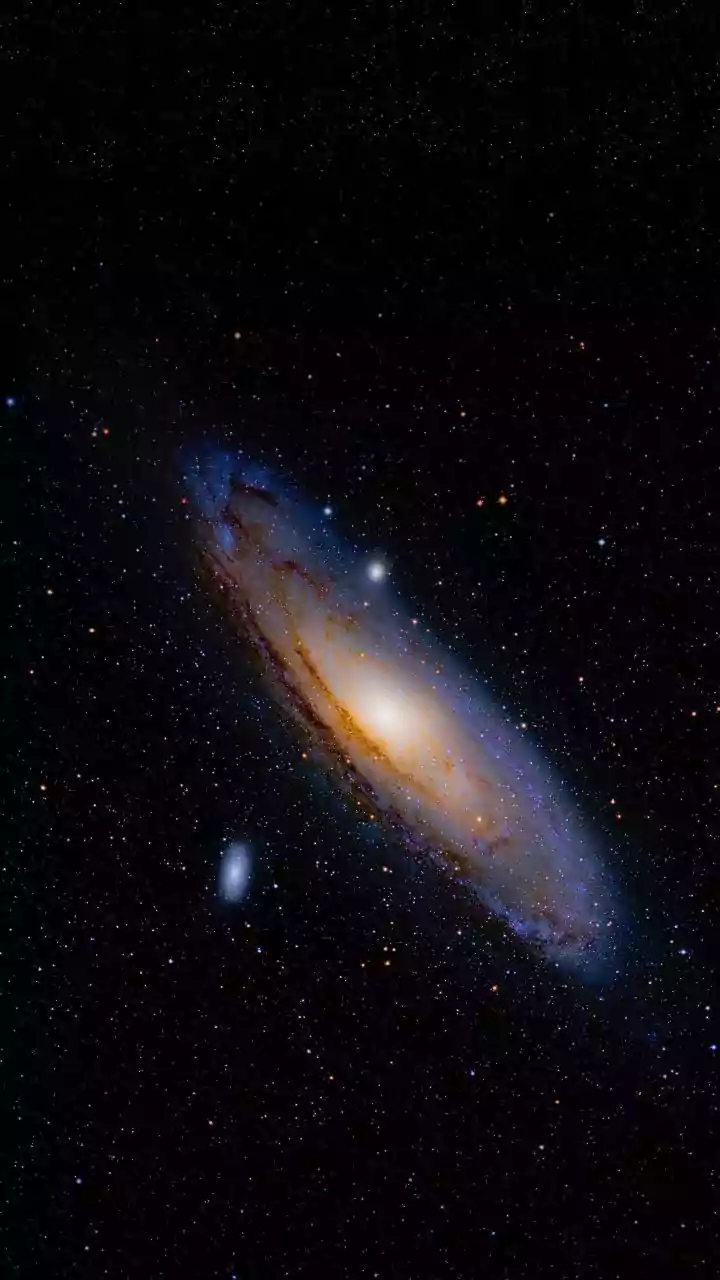
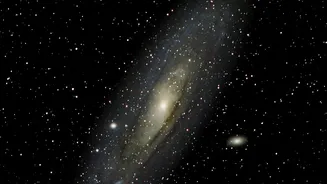
Just 2.5 million light-years away, the Andromeda galaxy, also known as M31, is the closest major spiral galaxy to our own Milky Way. Visible to the naked eye as a faint smudge in a dark night sky, it is a colossal structure containing an estimated one
trillion stars, stretching across a diameter roughly twice that of the Milky Way. For astronomers, Andromeda is a perfect cosmic laboratory. Its proximity allows telescopes like Hubble to resolve individual stars, providing a detailed 'fossil record' of how galaxies form and evolve over billions of years. This relationship is not static; Andromeda and the Milky Way are on a collision course, destined to merge into a single giant galaxy in about 4 to 10 billion years. But long before that cosmic crash, Andromeda is telling a different story—one of aging and transition.
The Fading 'Rings of Fire'
Much of Andromeda's recent star-making has not been spread evenly. Instead, it has been concentrated in enormous, overlapping rings of gas and dust. A particularly prominent ring, located about 32,000 light-years from the galactic core, has been a hotbed of stellar birth. This structure, sometimes nicknamed a 'ring of fire', is where cold gas clouds collapse under gravity to form new stars. However, a new comprehensive study, combining data from two major Hubble surveys, has revealed that activity in this very ring is slowing down significantly. By mapping the age and location of about 200 million individual stars, astronomers have pieced together a detailed history of the galaxy's activity. The story they uncovered is one of a steady decline.
A Galaxy Winding Down
The latest Hubble findings show that Andromeda's star formation has been decreasing for the last 500 million years, with the slowdown becoming even more pronounced in the last 40 million years. To put it in perspective, 500 million years ago, Andromeda was creating stars at a rate equivalent to about one of our suns per year. Today, that rate has plummeted to just one-fifth of a solar mass annually. Interestingly, this isn't because the galaxy is running out of fuel. There is still plenty of raw material—gas and dust—to form new stars. Instead, the slowdown seems to be a natural winding-down process following a much more energetic past. Around two billion years ago, Andromeda likely experienced a massive burst of star formation, probably triggered by a merger or interaction with another, smaller galaxy. Now, it appears to be entering a quieter phase, what one researcher described as taking a 'breather' after running a marathon.
A Glimpse into the Future?
This transition marks Andromeda's entry into its cosmic 'middle age,' moving from a highly active galaxy to a more quiescent state. This process offers vital clues about the life cycles of massive spiral galaxies like our own. As we observe Andromeda's star-forming rings fade, we may be getting a preview of the Milky Way's own distant future. The study also looked at the potential influence of Andromeda's small satellite galaxy, M32. Researchers found a 'dead zone' with very little recent star birth in the part of Andromeda's disk closest to M32, suggesting the smaller galaxy may have punched through it, disrupting the star-forming gas clouds in its wake. While not definitive, M32 is considered a 'likely suspect' in contributing to some of the localised slowdown. By studying these details, scientists can refine their models of galactic evolution and better understand the forces that shape the cosmos.