








Reading the Galactic Fossil Record
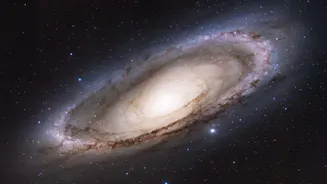
A comprehensive new census using NASA's Hubble Space Telescope has found that star formation in the Andromeda galaxy has been declining for the last 500 million years. More surprisingly, this slowdown has accelerated, with an even steeper drop over the last 40
million years. This discovery comes from a painstaking analysis of roughly 200 million individual stars across two-thirds of the galaxy's disk, combining data from two major surveys: the Panchromatic Hubble Andromeda Treasury (PHAT) and its southern counterpart, PHAST. Astronomers can read a galaxy's history by studying its stars, which act as a kind of fossil record. Massive, young stars burn hot and blue but have short lifespans, while older, smaller stars glow red for billions of years. By mapping the colors and brightness of stars across Andromeda, scientists can reconstruct when and where star formation was most active.
A Fading Ring of Fire
The new data shows Andromeda's star birth rate has fallen dramatically. Around 500 million years ago, the galaxy was creating stars equivalent to about one solar mass per year. By 40 million years ago, that rate had been cut in half. Today, it has plummeted to just one-fifth of a solar mass annually. This decline isn't happening uniformly across the entire galaxy. Researchers found that most of the recent star-making activity has been concentrated in a huge ring about 32,000 light-years from the galactic center. It is the fading of this prominent star-forming ring that is driving the galaxy-wide slowdown. This suggests Andromeda isn't necessarily running out of the raw gas and dust needed for star birth. Instead, it seems to be naturally winding down from a more energetic past. As lead author Tobin Wainer described it, "It's just like after running a marathon, sometimes you've got to take a bit of a breather."
A Tale of Two Histories
This period of quiet follows a much more tumultuous era. Previous research showed that Andromeda experienced a massive burst of star formation about two billion years ago. This stellar baby boom was likely triggered by a major cosmic event, such as a merger or close encounter with another galaxy. Since that peak, the galaxy has been on a long, steady decline, transitioning from an active period to a more quiescent state. Scientists also investigated a potential culprit for a localized drop in activity: Andromeda's small satellite galaxy, M32. They found that the region of Andromeda's disk closest to where M32 appears in the sky showed a pronounced decrease in star formation that began around 60 million years ago. While astronomers can't definitively say M32 is the cause, its presence makes it a prime suspect for disrupting at least one of Andromeda's stellar nurseries.
A Glimpse of Our Own Future
Understanding Andromeda's evolution is more than just an academic exercise; it provides a unique window into the life cycle of large spiral galaxies like our own Milky Way. Located about 2.5 million light-years away, Andromeda is our closest major galactic neighbor, making it a perfect laboratory for study. By observing its transition into a quieter phase, we get a preview of the eventual fate that may await our home galaxy billions of years from now. This detailed mapping of Andromeda's history will be expanded upon by future observatories like NASA's Nancy Grace Roman Space Telescope. Its wider field of view will allow astronomers to image the entire galaxy and its halo, providing a more complete picture of how large galaxies evolve and eventually fade.