



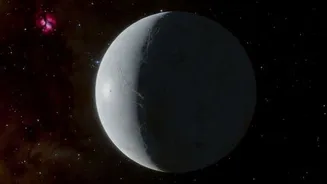
Far out in the darkness of our solar system, the ice giant Neptune seems like it should be a quiet, frozen world. But this deep blue planet is home to unimaginable violence, with the fastest winds ever recorded on any planet.
Just How Fast Are These Winds?
To understand Neptune's weather,
you have to throw out any earthly comparisons. The strongest hurricanes on Earth barely reach 300 kilometres per hour. On Neptune, winds routinely howl at more than 2,000 km/h. That’s more than five times faster than our most violent storms and faster than the speed of sound on our planet. These are not just breezes; they are supersonic currents of frozen methane and gas, whipping around the planet in a constant, furious frenzy. When NASA's Voyager 2 spacecraft flew past in 1989, it clocked these incredible speeds, revealing a world far more dynamic and violent than anyone had expected from a planet so far from the sun's warmth and energy.
The Mystery of Neptune's Engine
This extreme weather presents a giant puzzle for scientists. On Earth, our weather is powered almost entirely by the sun. Planets like Jupiter and Saturn, which also have fast winds, are closer to the sun and have strong internal heat sources. Neptune, however, is the eighth and farthest known planet, receiving less than 0.1% of the solar energy that Earth does. So, what powers its atmospheric engine? The leading theory points to a powerful internal heat source. Neptune radiates more than twice the energy back into space than it receives from the distant sun. This internal furnace is thought to be the primary driver, creating convection currents that churn its atmosphere and fuel the supersonic winds, making it a self-powered weather machine.
The Great Dark Spot
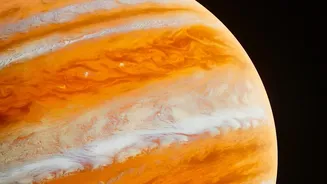
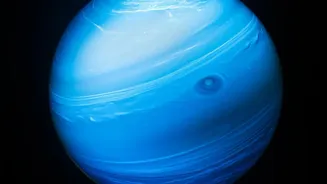
The most famous feature of Neptune’s turbulent atmosphere was the 'Great Dark Spot', a colossal storm system discovered by Voyager 2. Roughly the size of Earth, this massive, dark blue vortex was an anticyclone, spinning in a counter-clockwise direction with ferocious winds at its edge. It was visually similar to Jupiter’s Great Red Spot but proved to be far less permanent. When the Hubble Space Telescope turned its gaze toward Neptune in 1994, the spot had vanished completely. Since then, other, smaller dark spots have appeared and faded, highlighting just how rapidly Neptune’s atmosphere can change. These transient mega-storms are the most dramatic evidence of the powerful forces at work deep within the planet.
A World of Blue Ice and Diamonds
Beyond its winds, Neptune is a planet of beautiful and strange extremes. Its stunning blue hue, much more vivid than its neighbour Uranus, comes from methane gas in its atmosphere, which absorbs red light and reflects blue light. But this is no gentle blue ocean. The atmosphere is a frigid mix of hydrogen, helium, and methane, with temperatures plunging to around minus 225 degrees Celsius, cold enough for methane to freeze into ice clouds. The immense pressure deep within the planet is thought to be so great that it breaks down methane molecules, compressing the carbon atoms into a crystalline structure. The result? Scientists theorise that it might literally rain diamonds deep inside Neptune's interior.
Why This Distant World Matters
Studying a planet as remote and hostile as Neptune is more than just a curiosity. It challenges our understanding of how planets form and how their atmospheres work. Understanding the physics behind Neptune's internally powered weather system helps scientists model planetary climates under a wide range of conditions. This is crucial knowledge as we discover thousands of exoplanets orbiting other stars, many of which may be similar 'ice giants'. Neptune serves as our own solar system's laboratory for extreme weather, a benchmark for understanding the wild and wonderful possibilities that exist in planetary science across the galaxy.