






The Challenge of Thin Air
As you ascend, air pressure drops, and each breath delivers fewer oxygen molecules to your body. This state, known as hypoxia, forces your system to work harder to supply oxygen to your brain and muscles. Your body's first response is to breathe faster
and deeper, and your heart rate increases. This is the beginning of a complex process called acclimatization, where your body gradually adapts to function with less available oxygen. However, this process is slow and cannot be rushed by fitness or willpower alone. Going too high too fast is the primary cause of altitude-related illnesses, as it overwhelms your body's ability to adjust.
Why Sleep Is the Critical Factor
Acclimatization doesn't happen when you're pushing hard uphill; it primarily occurs during rest and, most importantly, during sleep. However, altitude itself makes quality sleep difficult. Respiration naturally slows during sleep, which can exacerbate the lack of oxygen. Many people experience a phenomenon called periodic breathing, where they alternate between rapid breaths and brief pauses, leading to a restless night and a feeling of suffocation that can wake them up. This is why your sleeping altitude—the elevation where your body must recover overnight—is the single most important metric to control. Staying at a sleeping altitude your body can handle allows for the crucial physiological changes to take place, while sleeping too high causes sustained stress that hinders adaptation.
The Golden Rule: Climb High, Sleep Low
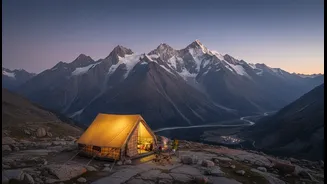
This classic mountaineering maxim is the most practical advice for any high-altitude endeavor. The principle is simple: it's perfectly fine to expose your body to a higher altitude during the day, as this provides the stimulus for acclimatization. But you must then descend to a lower elevation to sleep, giving your body a less stressful environment to recover and adapt. This strategy has been proven to significantly reduce the incidence of Acute Mountain Sickness (AMS). For example, on a trek, you might hike from your camp up to a ridge several hundred metres higher for the view, spend an hour there, and then return to the same camp to sleep. This balances the need for stimulus with the essential requirement for recovery.
Planning a Safe Ascent Profile
A well-paced itinerary is your best defense against altitude sickness. Mountain medicine experts provide clear guidelines based on sleeping elevation. A general rule of thumb is to avoid ascending to a sleeping altitude above 9,000 feet (about 2,750 metres) on your first day. Once above that point, you should limit the increase in your sleeping altitude to no more than 1,000 to 1,600 feet (300 to 500 metres) per night. Furthermore, it is recommended to schedule a rest day—where you sleep at the same altitude for a second night—for every 3,000 feet (roughly 1,000 metres) of elevation gained. This gives your body essential time to catch up and solidify its adaptations before you push higher.
Listen to Your Body's Signals
Even the best-laid plans must be flexible, because everyone acclimatizes at a different rate. The earliest signs of Acute Mountain Sickness (AMS) often include a persistent headache, nausea, fatigue, dizziness, and difficulty sleeping. These symptoms are a clear warning that you have ascended too quickly for your body to cope. The most important rule is to never ascend to a higher sleeping altitude if you are experiencing symptoms of AMS. If your symptoms are present but mild, stay at your current elevation until they subside. If they worsen, the only effective treatment is to descend immediately.