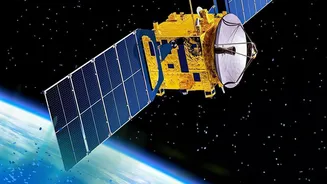








India is channelling significant funds into its next technological frontier: space. A new Rs 128.11 crore project to develop a constellation of AI-powered satellites just received major government backing, signalling a pivotal moment for the nation.
The Core of the Initiative
In
a significant push for sovereign technological capabilities, India has approved a project worth Rs 128.11 crore to develop an indigenous, AI-enabled satellite constellation. The Technology Development Board (TDB), operating under the Department of Science and Technology, has committed Rs 64.05 crore in funding to the Bengaluru-based startup Astrome Technologies to bring this ambitious plan to life. This funding, provided as Optionally Convertible Debt, represents half of the total project cost and is designed to support deep-tech innovation crucial for national security applications. The project aims to create a sovereign space-based intelligence system, enhancing India's strategic autonomy.
What is an AI-ELINT Satellite?
Unlike traditional spy satellites that capture images, this project focuses on 'Electronic Intelligence' or ELINT. These satellites are designed to detect, intercept, and analyse electronic signals, such as radio and radar emissions from ground stations, ships, and aircraft. While optical satellites can be hindered by cloud cover or darkness, ELINT satellites can 'listen' continuously, regardless of weather or time of day. The 'AI' component is a game-changer. AI-based software on the ground will sift through vast amounts of collected signal data, identifying anomalies, classifying threats, and prioritising information for human analysts. This automates a complex process, allowing for quicker and more efficient threat detection.
A Constellation for Constant Coverage
The project involves developing and deploying a series of microsatellites, each weighing around 50 kg, into Low Earth Orbit (LEO). Rather than a single satellite, the plan is to create a constellation—a network of satellites working in unison. This approach dramatically increases the frequency of observation over areas of interest, providing persistent surveillance of borders and maritime regions. The satellites will feature inter-satellite communication links, allowing them to share data directly with each other, forming an integrated and responsive network without always needing to wait for a ground station pass. The initial goal is to launch three satellites, with a much larger constellation planned for the future.
Strategic Importance for India
This Rs 128.11 crore investment is more than just a funding deal; it's a strategic move to bolster India’s national security infrastructure and deep-tech ecosystem. Developing a sovereign capability in electronic intelligence reduces reliance on foreign technology and data for critical security and defence applications. The project aims to take the core technologies from a mid-level Technology Readiness Level (TRL-4) all the way to a fully operational and proven system (TRL-9). This initiative aligns with India's broader goals in the space sector, which have seen a surge in private participation and innovation since the establishment of IN-SPACe, the country's private space sector regulator. Experts note that AI is becoming central to making space missions more autonomous, efficient, and economically viable.