


The Problem with Power on the Moon
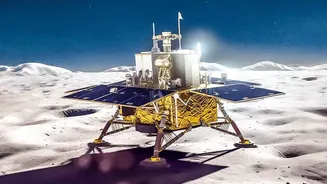
Establishing a permanent human presence on the Moon, as envisioned by NASA's Artemis program, is not as simple as just landing and setting up camp. A sustained lunar base requires a constant, reliable power source to run habitats, life support systems,
scientific experiments, and rovers. The most obvious solution, solar power, faces a major hurdle: the long lunar night. A night on the Moon lasts for about 14.5 Earth days, a period of extreme cold and total darkness where solar panels are useless. While massive battery storage is theoretically possible, the weight would make it prohibitively expensive to launch. Furthermore, many areas of scientific interest, like permanently shadowed craters at the lunar poles that may contain water ice, never see sunlight at all.
The Nuclear Solution: Fission Surface Power
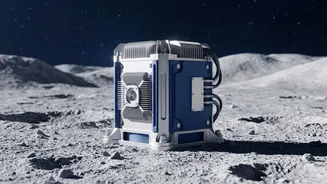
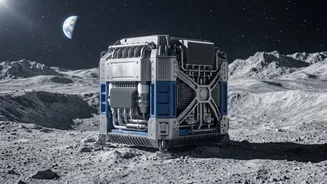
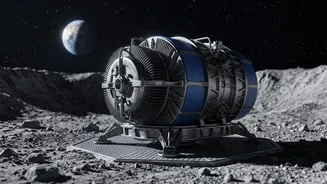
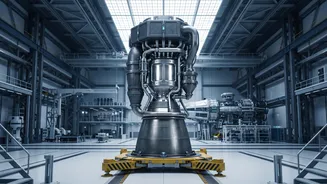
To solve this energy crisis, NASA has partnered with the U.S. Department of Energy (DOE) on the Fission Surface Power (FSP) project. The goal is to develop a small, portable nuclear fission reactor that can be transported to the Moon and provide a steady stream of electricity for at least a decade without refueling. The initial target is a system capable of generating at least 40 kilowatts, enough to continuously power around 30 households on Earth. This 'nuclear battery' would be a game-changer, enabling long-duration missions and a power-rich environment for a future lunar economy. A demonstration on the Moon is planned to pave the way for eventual use on Mars, where planet-wide dust storms can render solar power unreliable for months.
Challenge 1: Size, Weight, and Safety
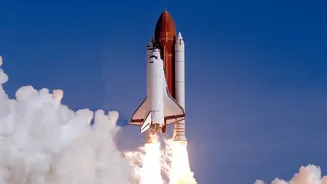
One of the primary research challenges is engineering. The entire system—reactor, power conversion, and heat rejection—must be lightweight and compact enough to fit on a single rocket and survive the intense forces of launch. NASA's initial specifications required the entire system to weigh less than six metric tons. At the same time, it must be incredibly robust. Safety is the top priority, starting with the launch itself. The reactor will be launched 'cold', containing fresh uranium fuel that is only weakly radioactive to mitigate the risk of dispersing hazardous material in the event of a launch failure. Once operational on the Moon, the system needs substantial radiation shielding to protect astronauts, which adds significant weight and complexity to the design.
Challenge 2: Surviving the Harsh Lunar Environment
The Moon is an unforgiving place. Without an atmosphere to burn up meteoroids, the reactor will face a constant threat of impacts from space debris. This has led some to suggest burying the reactor under the lunar surface for protection. Another major issue is heat rejection. Fission generates immense waste heat, but in the vacuum of space, there is no air or water for cooling. Engineers are designing large radiator panels to shed this heat directly into space, but these add mass and are vulnerable to the Moon's other big threat: abrasive dust. This fine, electrically charged dust, called regolith, can coat surfaces, clog mechanisms, and reduce the efficiency of the radiators.
Challenge 3: Autonomous Operation and Geopolitical Urgency
This lunar reactor can't have a team of engineers constantly monitoring it. The system must be designed for near-autonomous operation, capable of running itself and even shutting down safely in an emergency, like a moonquake, without human intervention. This requires sophisticated and resilient control systems. The project is also driven by a sense of urgency. The U.S. hopes to have a reactor on the Moon by 2030, in part because of a new space race with China and Russia, who have announced a joint plan to deploy their own lunar reactor by the mid-2030s. Being the first to establish a reliable power source could set the standard for future lunar commerce and exploration.