





An Eye in Orbit on the Deep Earth
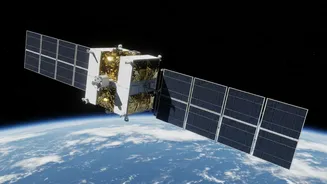
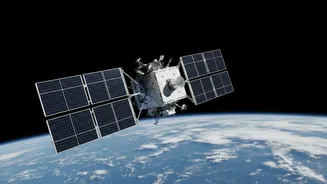
You can’t see through thousands of kilometres of rock. So how do scientists study the planet’s core? The answer lies in space. Missions like the European Space Agency's (ESA) Swarm constellation, a trio of satellites launched in 2013, can't directly image
the core. Instead, they carry highly sensitive instruments called magnetometers that precisely measure Earth’s magnetic field. By tracking tiny fluctuations and wobbles in this field over time, scientists can work backwards, inferring the motion of the electrically-conducting liquid iron in the outer core, which generates the field in the first place. This technique provides an unprecedented, indirect view of the dynamic processes unfolding nearly 3,000 kilometres beneath the surface.
The Planet's Churning Engine
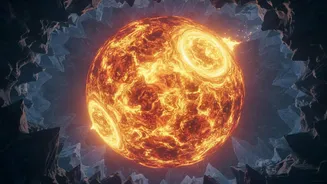
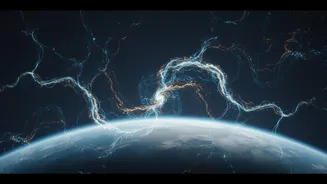
Earth’s outer core is a superheated ocean of liquid iron and nickel that swirls around a solid inner core. This constant motion, driven by the planet's cooling, functions like a colossal dynamo, generating powerful electric currents. These currents, in turn, produce the vast magnetic field that envelops our planet, known as the magnetosphere. This field is not just a scientific curiosity; it is essential for life, acting as a protective shield that deflects harmful solar radiation and charged particles from the sun. For decades, scientific models showed this flow was dominated by a steady westward drift. But recent discoveries have revealed this engine is far more restless than we knew.
A Sudden and Surprising Reversal
Analysis of satellite and ground-based data collected over decades revealed something astonishing. Around 2010, a massive current of molten iron deep beneath the Pacific Ocean, which had been flowing weakly westward, abruptly changed direction and began surging eastward. This was not a minor eddy but a significant shift affecting a large region, representing about 5% of the outer core's surface flow. The discovery, detailed in recent studies, challenges the long-held assumption that the core's large-scale circulation was a relatively stable, slow-changing system. It shows that dramatic, regional changes can happen within the span of just a single decade.
The Link to 'Geomagnetic Jerks'
Scientists believe this core-flow reversal may be connected to phenomena known as “geomagnetic jerks.” These are not physical jolts, but rather sudden, sharp accelerations in the way the magnetic field itself changes. These jerks occur irregularly, on average about once a decade, and are thought to be caused by rapid changes in the core's fluid flow, possibly from buoyant blobs of molten material rising or powerful magnetic waves. The 2010 flow reversal preceded a notable geomagnetic jerk recorded over the Pacific in 2017, suggesting a direct link between the deep fluid dynamics and the subsequent changes observed in the magnetic field.
Why This Discovery Matters
While these deep-Earth changes pose no immediate danger to us on the surface, they are fundamentally important to understanding how our planet works. The magnetic field is crucial for protecting our atmosphere and the technological infrastructure we rely on, from navigation systems to power grids. By studying these rapid changes in core flow, scientists can refine their models of the geodynamo. The latest data suggests the eastward flow has been weakening since 2020, raising new questions: was this a temporary fluctuation, part of a longer natural cycle, or the beginning of a new pattern? Answering these questions is key to better predicting the long-term evolution of our planet's protective magnetic shield.