


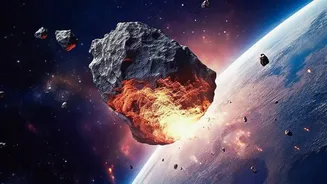
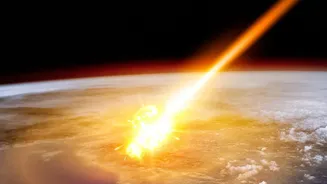

When it comes to protecting Earth from a potentially hazardous asteroid, the plan seems simple: just knock it off course. But new research reveals a critical complication, showing that an asteroid's lumpy, uneven shape is more than a cosmetic detail.
The Cosmic Billiards Problem
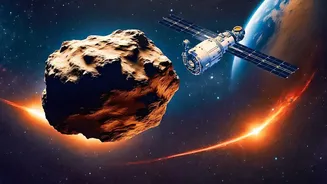
For decades, scientists have been developing strategies for planetary defense. The most tested method is the 'kinetic impactor', which involves crashing a spacecraft into an asteroid to alter its path. This was famously demonstrated by NASA's DART (Double Asteroid Redirection Test) mission in 2022, which successfully changed the orbit of the asteroid moonlet Dimorphos. However, early models often simplified the problem by treating asteroids as perfect spheres. New simulations from Sandia National Laboratories show that reality is far more complex. The research, published in the journal Icarus, highlights that the irregular, potato-like shapes of real asteroids mean that where you hit them matters immensely.
Why Shape Changes Everything
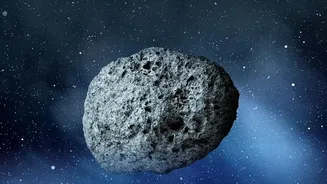
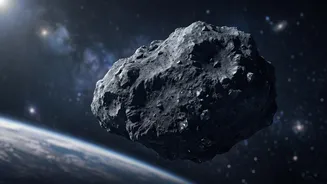
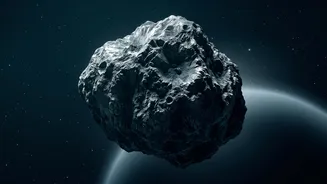
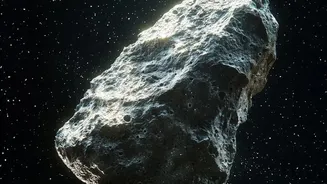
An asteroid's uneven surface, with its ridges, craters, and slopes, complicates any deflection attempt. Imagine pushing a bowling ball versus pushing a lopsided rock. The ball will roll predictably, but the rock might just spin in place or veer off in an unexpected direction. The new simulations reveal a similar effect in space. Researchers found that applying the same force to different spots on the same simulated asteroid could change the resulting deflection by nearly a factor of five. Hitting one side might give it a solid nudge, while hitting another could impart a wild spin, making its new trajectory even harder to predict. In one simulated case, the change in an asteroid's rotational speed varied by a factor of 17 depending on where the force was applied.
From Perfect Spheres to Lumpy Potatoes
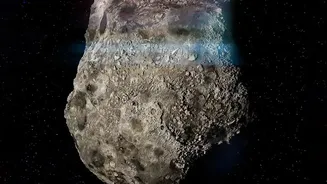
The reason previous models often used spheres is that the math is much simpler. Factoring in the true, complex topography of an asteroid requires immense computational power. The latest research overcomes this by using a new, faster algorithm that can model realistic asteroid shapes without sacrificing accuracy. Scientists simulated the effects of a standoff nuclear explosion, where X-rays vaporize the asteroid's surface to create a propulsive push. This method is considered an option for large asteroids discovered with little warning time. By applying this model to known asteroids like Bennu and Itokawa, the study confirmed that deflection effectiveness is critically dependent on both the asteroid's shape and the angle of the blast.
Informing the Next Generation of Defence
These findings are crucial for the future of planetary defense. The DART mission showed a kinetic impactor can work, but it also revealed surprises. The impact created far more debris and changed the asteroid's shape more than expected, suggesting Dimorphos was not a solid rock but a looselyheldtogether 'rubble pile'. This underlines how little we know about the internal structure and composition of these objects. Understanding how an irregular, rubblepile asteroid responds to an impact is vital. Future missions, like the European Space Agency's Hera, which will visit Dimorphos in 2026 to study the aftermath of the DART impact, will provide more of this essential data. This new simulation research adds another layer, showing that we not only need to know what an asteroid is made of, but we also need a detailed 3D map of its shape to plan an effective deflection.
A Blueprint for Saving the Planet
The threat of a civilizationaltering asteroid impact is low, but the potential consequences are enormous, making proactive research a global priority. This study moves planetary defense away from a game of chance and toward a precise science. It proves that a 'onesizefitsall' approach is not enough. To successfully nudge a hazardous asteroid away from Earth, mission planners will need to know its shape in detail. 'We expected aim to matter,' said Nathan Moore, the Sandia physicist who led the research. 'What surprised us was how much'. This knowledge could be the difference between a successful deflection and a failed one, turning a potential catastrophe into a near miss. The goal is to make asteroid impacts the only natural disaster we have the power to prevent entirely.