





The Science: A Cosmic Alignment
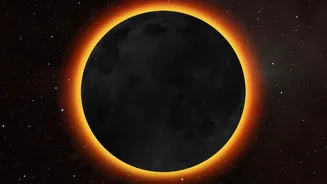
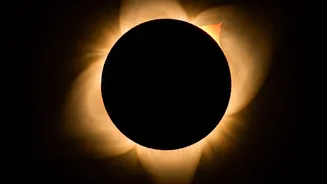
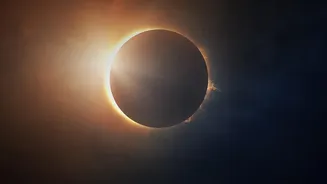
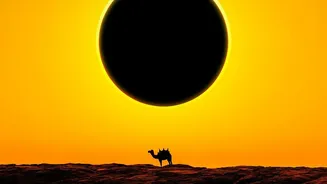
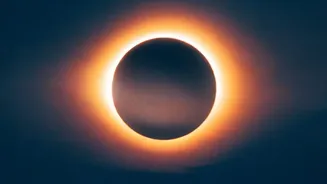
From a scientific standpoint, an eclipse is a predictable and elegant alignment of celestial bodies. A solar eclipse occurs when the Moon passes between the Sun and Earth, casting a shadow on our planet. For those within the darkest part of this shadow,
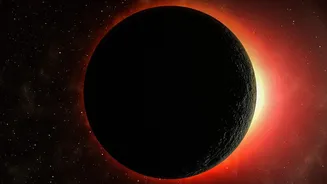
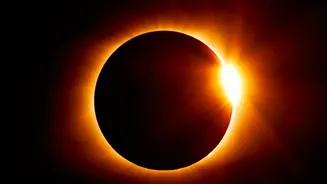
the umbra, day turns to an eerie twilight in a total solar eclipse. A lunar eclipse happens when Earth moves directly between the Sun and the Moon, casting its own shadow onto the lunar surface, often giving it a reddish glow as sunlight filters through our atmosphere. There is no malevolent force at play; it is simply orbital mechanics. This rare alignment, however, provides a golden opportunity for science. During a total solar eclipse, astronomers get a rare glimpse of the Sun's outer atmosphere, the corona, which is normally obscured by the star's own brilliance. These fleeting moments have led to major discoveries, including confirming Einstein's theory of general relativity and revealing the corona's surprisingly high temperatures.
The Myth: A Tale of Gods and Demons
Hindu mythology tells a different story, one rooted in the cosmic event known as the Samudra Manthan, or the Churning of the Ocean. In this tale, the gods (Devas) and demons (Asuras) worked together to churn the ocean to obtain Amrit, the nectar of immortality. When the nectar emerged, Lord Vishnu took the form of a beautiful maiden, Mohini, to trick the Asuras and distribute it only among the gods. However, one Asura, Svarbhanu, disguised himself as a god and managed to drink a drop. The sun god, Surya, and the moon god, Chandra, spotted the deception and alerted Mohini, who swiftly beheaded the demon with her divine discus. But because he had tasted the nectar, he did not die. His head became Rahu, and his body became Ketu. Filled with eternal vengeance against Surya and Chandra for exposing him, Rahu is said to periodically swallow the sun or moon, causing an eclipse. Since he has no body, the celestial bodies eventually re-emerge from his throat.
Ritual Practice: A Time of Caution
The mythological narrative gives rise to a set of deeply ingrained rituals and precautions observed by many Hindus during an eclipse. The period is often considered inauspicious, a time when negative energies are believed to be prevalent. This leads to the observance of a 'Sutak' period, which begins several hours before the eclipse (12 hours for a solar eclipse, 9 for a lunar one) and ends only after it is over. During Sutak, many activities are avoided. People may refrain from cooking or eating, believing food can become contaminated. Temples often close their doors, and prayer is done privately. It's also a common practice to place Tulsi (holy basil) leaves in stored food and water to protect them from impurities. Pregnant women are sometimes advised to take special care to shield the unborn child from negative influences.
One Sky, Two Narratives
In modern India, these two stories—the scientific and the mythological—coexist in a fascinating way. An astrophysicist might understand the precise mechanics of the Moon's shadow while their family observes a fast. A student may learn about the corona in school but still see their elders place Tulsi leaves on food at home. This isn't necessarily a contradiction. The scientific explanation answers the question of 'how' an eclipse happens, detailing the physical laws of the universe. The mythological narrative and its associated rituals address a different need: the 'why' and 'what does it mean'. They provide a framework for cultural connection, spiritual reflection, and a sense of order in a cosmic event that can feel overwhelming. The scientific view turns the eclipse into a laboratory in the sky, while the traditional view transforms it into a powerful moment for spiritual practice, where chanting and charity are believed to be especially potent.