
The Original Mission
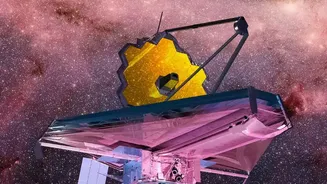
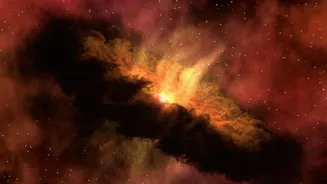
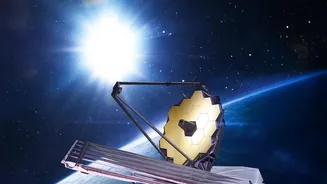
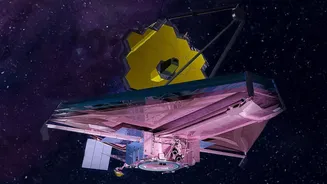
The James Webb Space Telescope (JWST) was pointed at a familiar star system, Beta Pictoris, located about 63 light-years from Earth. This system is a fascinating subject for astronomers; it's relatively young, at around 23 million years old, and features
a bright disk of dust and debris—the raw material for planet formation. Scientists already knew of two giant planets orbiting the star, named Beta Pictoris b and c. The goal for this particular observation was to use Webb's powerful Near-Infrared Spectrograph (NIRSpec) to study the atmosphere of Beta Pictoris b, one of the very first exoplanets ever to be directly imaged by telescopes. By analyzing the light that filters through a planet's atmosphere, Webb can identify the chemical elements present, giving scientists clues about its composition and environment.
An Unexpected Signal
As the team of astronomers, led by Aidan Gibbs of the University of California, San Diego, analyzed the data from Webb, they noticed something odd. The NIRSpec instrument doesn't just take a single picture; it creates a detailed map of chemical information across its field of view. Buried within this complex data was an unexpected bright spot—a distinct chemical fingerprint that didn't belong to the star or the known planet. It was the signature of an entirely different planetary atmosphere, revealing the presence of methane, carbon monoxide, and water vapor. It wasn't a fluke. The telescope had accidentally discovered a third planet in the system, which has now been named Beta Pictoris d. This marked a new and powerful way to find worlds, not by seeing them as a point of light, but by detecting the unique chemical makeup of their air.
A Tale of Three Planets
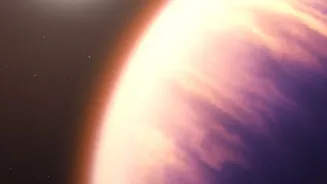
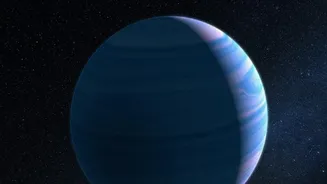
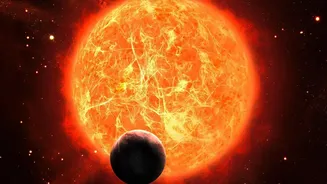
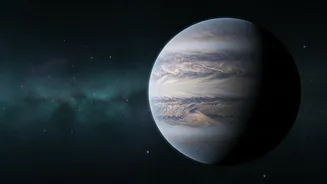
The newly found Beta Pictoris d joins its two siblings in a system that is quickly becoming a key laboratory for understanding how planets form and evolve. Beta Pictoris d is a gas giant, estimated to be at least twice the mass of Jupiter, and it has the widest orbit of the three known planets in the system. What makes its discovery so remarkable is that it was essentially hidden by the system’s bright debris disk, which had thwarted previous searches for over a decade. While ground-based telescopes were eventually able to spot it after the fact using advanced imaging techniques, it was Webb’s unique ability to see through the cosmic dust and isolate the planet’s atmospheric signature that made the initial, serendipitous discovery possible. This makes Beta Pictoris only the second planetary system known to have at least three directly imaged planets.
A Triumph for Webb's Technology
This discovery is more than just another exoplanet added to the catalogue; it's a powerful demonstration of the James Webb Space Telescope's transformative capabilities. Finding a planet not by its faint glow, but by the specific gases in its atmosphere, is a technique that could revolutionize the search for worlds around other stars. It shows that Webb can parse incredibly complex light signals to pull out the signature of a hidden planet from the glare of its star and surrounding dust. This success highlights the telescope's incredible sensitivity and the new avenues of research it opens. Scientists can now be on the lookout for unexpected atmospheric signals in other systems, potentially revealing planets that other detection methods would miss. Each surprise discovery like Beta Pictoris d reinforces the value of this premier space observatory and its potential to continue solving mysteries across the cosmos.