

A Glimpse into Our Sun's Future
Located roughly 6,500 light-years away, NGC 2392 is a planetary nebula—the glowing, expanding shell of gas shed by a star like our own Sun at the end of its life. The term is a historical misnomer, as these objects have nothing to do with planets. Instead,
they are the beautiful remnants left behind when a star exhausts its nuclear fuel, puffs off its outer layers, and leaves behind a super-hot, dense core known as a white dwarf. This new portrait from Webb offers a preview of the fate that awaits our own solar system in about five billion years, making it a subject of intense scientific interest.
The Power of Webb's Infrared Eyes
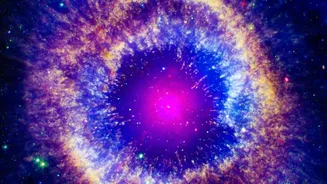
While the Hubble Space Telescope gave us stunning visible-light images of this nebula in 2000, Webb's ability to see in infrared light reveals a new layer of reality. Infrared is crucial for cutting through the shroud of gas and dust, allowing astronomers to see the different structures and temperatures within the nebula with incredible clarity. The composite image combines data from two of Webb's key instruments: the Near-Infrared Camera (NIRCam) and the Mid-Infrared Instrument (MIRI), each telling a different part of the story.
What NIRCam and MIRI Reveal
The combined view from NIRCam and MIRI showcases the nebula's complex architecture, created by the central white dwarf. This stellar remnant, appearing like a small, bright 'nose,' is intensely hot and blasts out radiation, 'cooking' the surrounding material from the inside. This process creates a bubble of ionized gas, which forms the inner 'face' of what some call the Lion Nebula. MIRI is particularly adept at highlighting the filamentary structures of dust in the outer 'mane.' Some of these delicate dust filaments are being destroyed by the star's radiation, while others manage to survive, creating a dramatic scene of cosmic creation and destruction.
A Story Written in Gas and Dust
The intricate details in Webb's image help astronomers piece together the nebula's history. The overall structure is the result of a slower wind from the star's earlier red giant phase interacting with a much faster wind from the exposed hot core. The 'mane' is composed of dense clumps of material that have survived the onslaught of radiation from the central star, protecting the gas and dust that lies behind them. These features, which look like the tufts of a lion's mane or comet-like tails, provide a snapshot of the dynamic processes shaping the nebula.
Why This Cosmic Portrait Matters
Beyond its sheer beauty, this image provides critical data for understanding the final stages of stellar evolution for the vast majority of stars in the universe, which are not massive enough to go supernova. It shows how elements forged inside a star are expelled and recycled back into the cosmos, eventually forming new stars and planets. Studying the complex rings and shells helps scientists refine their models of how these nebulae are shaped, a process that is still not fully understood. This detailed view of NGC 2392 provides a frozen moment in a process that has taken thousands of years to unfold and will continue for thousands more before the nebula completely disperses.